Nau mai, haere mai, welcome to eyeCONTACT, a forum built to encourage art reviews and critical discussion about the visual culture of Aotearoa New Zealand. I'm John Hurrell its editor, a New Zealand writer, artist and curator. While Creative New Zealand and other supporters are generously paying me and other contributors to review exhibitions over the following year, all expressed opinions are entirely our own.
Showing posts with label George fraser Gallery. Show all posts

Thursday, July 30, 2009

La femme à tête de chou-fleur


Mhairi-Clare Fitzpatrick and Robyn Hoonhout: Words Fail You
George Fraser Gallery
30 July - 1 August 2009

The pairing of these two Elam photographers is an interesting one because they are so different. One makes lightboxes for her images (backlit duratrans) that even when featuring living people, still in this context look like consumerable commodities for sale. The other shows pairs of women at work, in their places of employment, or in clubs, or neutral public spaces. There is no consistent pattern. The lighting conditions and the contextualising visual narrative keeps abruptly changing.

The most accessible images by Mhairi-Clare Fitzpatrick are of two young women in a freezing-works. An update of Darcy Lange perhaps, and in this show, they become positioned images of ‘authenticity’. Her other images seem overtly preoccupied with fakery, with odd smocks and wigs. They are bizarrely futuristic, as if off the set of A Clockwork Orange, but in ultra-violet light.

Robyn Hoonhout’s duratrans have pairs of objects (images of elderly women included) is if in a promotional campaign that might go in bus shelters. She seems to be contrasting human individuality with Fordist factory production - and deliberately mixing consumer with the consumed.

The essay by Lucille Holmes that goes with this show is in this context inappropriate, for like every other student theorist who has been writing over the last twenty-five years, she is obsessed with Roland Barthes’ Camera Lucida and his use of the term punctum. She is also keen to show her erudition with the writings of Lacan and exactly how Barthes derived punctum from Lacan’s eleventh seminar. This is precious little use for anybody trying to grapple with Hoonhout and Fitzpatrick’s imagery – and will probably send them fleeing screaming from the George Fraser, never to return.

Friday, May 22, 2009

Inside out


Tabatha Forbes & Karen Crisp: OUTSIDE

George Fraser
14 May - 23 May 2009

There are two shows here. One – in the back room – is a group of three large framed photographs; two high definition inkjet prints of tree-filled landscapes and one of Lake Rotorua. The other out front, presents a kauri table bearing over a hundred and fifty rotting apples that have all been tattooed. There is also a coloured photograph of a few of them, and there is a video on the floor (viewable only through a cardboard fruit-box placed on its side) of two walks, at dusk and dawn, around the perimeters of an old orchard.

These exhibitions are quite different. It’s odd that they have been juxtaposed together.

Karen Crisp’s very precise coloured images first impressed me in a Bath Street group show last year. These photographs too are remarkable. They have a subtle dreamlike (or fairytale) quality, a sense of otherworldliness. Their haunting atmosphere draws you back for repeated viewings - for their dimension of strange ‘oddness’ is hard to put your finger on. They are not creepy, just very mysterious. Nor are they ‘over the top.’ Everything is tightly controlled, nuanced and discreet.

Tabatha Forbes’ work to me seems unresolved. The many apples she tattooed should never have been taken off the orchard trees but engraved on site and left to drop naturally. The show is called ‘Outside’ and that is where it should have stayed. That is where the power of her idea could have been fulfilled.

Here’s why: If art needs a social environs to function (and admittedly I’m not entirely convinced that it does) these apples should be where people can discover them in a non-art context and be surprised. If that is not the point, but notions of decay and life’s transience (in the Dutch still-life tradition) are, then she needs to think about how nature’s processes interact with the meaning of the words. Her texts and images come from all over the place and lack focus. She is fetishising technique and ignoring content.

These are good issues to think about. The show finishes today (Sat) and the artists are giving a talk at 1.00 this afternoon at the gallery. Coffee provided.

Monday, August 25, 2008

Hard-headed watercolour


2008 Henrietta and Lola Anne Tunbridge Scholarship exhibition
George Fraser
21 August -30 August 2008

This is an unusual idea, to have a $10,000 prize for watercolourists. And as it turns out, it’s a pretty nuggetty show. Not really about manual dexterity in rendering as some might expect - more about attitude and concept. In fact it’s an avant–garde show. It takes an extreme position, and is the better for that.

Ron Brownson, the judge, Senior Curator at AAG, made a good choice in choosing the winner. A toss up between Charles Ninow or Mark Foster, I’d say. Ninow’s six sheets of hideously glossy light card featured small groups of tiny red and yellow squares (a reference to mosaic tessellations) - some of them pin dots – swamped in a field of white. Utterly bizarre but also very funny. Nice title too: Stability on Thursdays (Working Towards Stability on Mondays) #1-6.

Two of the entries (Seul Ki Kim and Wendy Hannah) are too sentimental for this context and looked out of place, but the rest – Andrew De Freitas, Nicola Farquhar, Ninow, Mark Foster, and Ash Kilmartin – helped construct a tight little exhibition that celebrates rigor and steely resolve.

Some artists' statements might have been a handy option, but not a necessity. The written word is overvalued now in art academia and tends to smother the experiential, but most viewers are likely to be curious about the motivation behind these works.

Wednesday, July 23, 2008

Elam Sculpture


Rory Dunleavy, Luke Willis Thompson, Shannon Teao: Deadline, Authentico!
George Fraser
16 - 26 July 2008

In this sculpture show we see three artists collectively use the two GF rooms in entirely different ways. In the front we see two photographs (Site A and Site B), each showing a pear-shaped chunk of wet clay that has been pulled out of a plastic bag, photographed, and then that photo painted to look as if white slip had been applied to the upper portions of the lump.

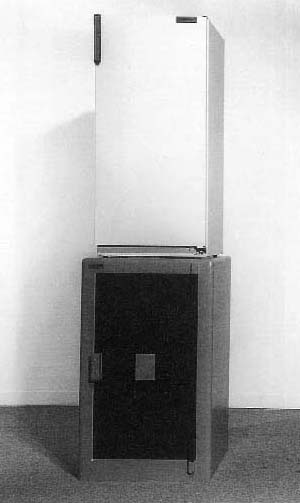
In the back room things are more complicated: twenty units positioned in a grid–like arrangement on the floor. Some test mainly binary combinations of unorthodox materials like clay and branches, polystyrene and cardboard, rock and paint, plaster and foil, wire and tape etc. Others investigate just what plinths might be; much like the French artist Bertrand Lavier who has done peculiar (but brilliant) things like placing a fridge upon a safe. Still others explore patterns of painted marks on odd materials and constructed Picassoesque ceramics. Others yet try transitive verb actions with materials, the ideas embodied in Richard Serra’s verb list for example, using processes like gravity or decay. Little bricks that have tumbled off the seat of a toppled chair. Clay blocks in a pile, some of which have been crumbled, or diminished in scale.

The result is a fascinating floor display that has energy and intelligence, is visually intriguing, and a great contast to the calm and quiet of the front room. An exceptionally good exhibition at George Fraser. A knock-out.

Saturday, May 31, 2008

Photographic explorations


im/ perfection: young Elam photographers
George Fraser Gallery, Auckland
29 May – 14 June 2008

Though the Gallery site claims this is a show of innovative photography that is not strictly the case. Much of the work by this group of a dozen senior Elam students is drearily conventional – occasionally even approaching touristy calendars. However the peaks are worth traipsing across Albert Park for.

Those highlights include Bella Lett’s black and white image of a peeling gum tree branch to which is tied a horizontal section of fishing line pulled tight. On it are attached dangling fishing hooks. The photo has an incongruous surrealist feel, with impeccable grey tones. The scene is contrived, yet the image’s proportions and peculiar placement of marine objects in the leafy air make it memorable.

Lana Matich contributes a coloured montage depicting a dilapidated old railway carriage. The overlapping rectangles, in a style that David Hockney popularised with his clusters of Polaroids in the early eighties, provide a cubist treatment of twisting planes that competes with the flatness of the modernist, collagist picture-plane.

Laurelle May’s gorgeously coloured and sharp night-time photographs have a delicate stillness reminiscent of the work of Hamilton photographer David Cook. Her precise understanding of light draws you close, especially in her image of a bedroom. Moonlight though a window behind the photographer reveals washes of subtle colour on the bed and surrounding furniture.

In her own treatment of her bedroom Anna Gardner's work is quite different, more a sculptural/conceptual project than a mere documentary image. When moving to a new flat she cut out a rectangle from the wall of her old room and spliced it into the wall of her new bedroom, and then rehung photographs, mirror and other personal bits and pieces exactly as before. That section of cut-out gib is leaning against the Gus Fisher wall below a typed explanation and photograph of an early cut, an intriguing meditation on the nature of presence.

Like Gardner, Alexander Hoyles combines photography with sculpture.Hoyles’ four alternating views of a young man’s head (maybe himself) are mirrored by the four sides of a glass pyramid held in a skeletal wooden tower. Possibly not a gimmick, it suggests something serious about the fleeting nature of visual sensations and the evanescent, mercurial nature of the self-observed self.

Robyn Hoonhout’s lightboxed transparency of an eldery woman in her underwear squatting on the floor is strangely disturbing while also beautiful. Admirable in its refutation of conventional ageist glamour it exploits a golden glowing light on the model’s skin. Because the advertising format is subverted by Hoonhout's content which contradicts the norms for such presentation, this is a daring image that needs to be shown in a more public location.

Kirsty MacDonald’s images are also particularly adventurous, being out of focus, indecipherable and much nuanced in colour – for at first glance they seem to be black and white. They are uncompromisingly enigmatic; wonderfully contemplative objects ruminating about the technology of the camera. Looking at what is detectable in hue and what is not, they challenge the viewer to speculate about their origins, as well as beguile and seduce. Like Hoonhout and Gardner especially, by-products of an exploratory process.

Thursday, May 15, 2008

Cohesive Combination


This Much is Certain: Alexandra Savtchenko, Sonya Lacey, and Sarah Rose (Elam Grad Exhibition)
George Fraser Gallery
7 May - 24 May 2008

These three Elam graduates showing together in the George Fraser have come up with a surprisingly tight exhibition – even though it was their supervisors who actually selected them for this project.

So why does it succeed? First of all, and most obviously, Sonya Lacey’s Structure for Standing while Talking (After Pistoletto) – a steel L-shaped sculpture that looks like a freestanding support for a lean-on-able bar in a pub - has ties with Sarah Rose’s Open Space, a large sign holder that looks like part of some monkey bars from a children’s playground.

Both major works function as metal forms (one is stripped of paint, the other is powdercoated) to be enjoyed as sculptures, but they could also work with human bodies swinging or leaning on them. They ‘beckon’ to passers by to be touched or climbed on, and reek of function and bodily interaction, not contemplative delectation. The participation of people with their rigid forms though is not essential. In fact, Rose doesn’t want people to touch her public sculpture, but because it looks like it is designed for children, and not art, her wishes will probably end up being ignored.

Rose has two other works in the show. One is a banner lying on the floor that is strangely folded so that its configured patterns point at the Open Space work outside the door. The other is a length of steel wire rope hanging from the ceiling and wall forming a suspended parabola. Its gravity induced, soft, round form is a vivid contrast to the rectangular hard contours of Open Space, and refreshingly casual.

Sonya Lacey’s Structure for Talking was once painted but she decided to strip that layer off and expose the ground, buffed steel. Her graphite drawings show that interest in surface, and both her preoccupations and Rose’s link well with Savtchenko’s video. Using a laptop Savtchenko presents films of billowing volcanic ash spilling out of erupting craters. She has also made a substraction work (related to the methods of seventies artists like Billy Apple) where she sanded and chipped away encrustations of paint from an internal gallery archway. Her removal process and images of suspended ash particles high in the air are a clever foil to the methodologies of her two colleagues. This is a rigorous, austere exhibition, but clearly a thoughtful one. It shows good teamwork without downplaying the significance of each individual contributor.