Showing posts with label City Art Rooms. Show all posts
Sunday, April 18, 2010
Young Sun Han performance
Young Sun Han: Dance Of The Cockatrice
City Art Rooms
6 April – 8 May 2010
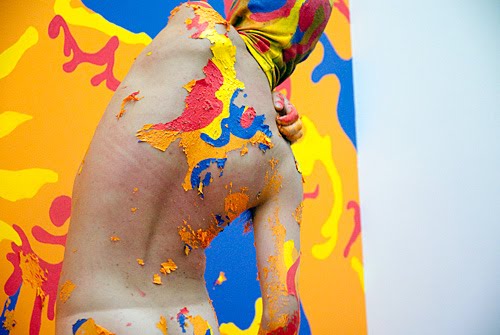
Artist, Curator and gallery sales-person of City Art Rooms (where I myself exhibit - I need to declare that), Young Han Sun here presents an installation of photographs made in anticipation of a performance in front of a live audience. These eight images were taken with a ‘practice’ mock up using a painted end wall - with the artist’s body carefully painted as well. Mounted and framed under glass, they are accompanied by a new painted wall created for the second ‘proper’ performance presented a week into the exhibition.
The hot cadmium yellow ‘camouflaged’ wall, being slightly darker in the photos, is quite overwhelming when experienced directly in the gallery. The pattern doesn’t so much reference popular youth fashion as Andy Warhol and his paintings of the mid-eighties. Instead of incorporating mottled landscape forms with subdued ‘earth’ colours as the army does, these were deliberately synthetic, bright and inorganic. Warhol eventually incorporated these motifs into his self-portraits, and here lies a connection with Young Sun Han’s project. Just as Warhol attempted to balance his fame as a popular ‘American’ artist with his need for privacy, coming from a family of Polish immigrants and being gay, Sun Han focuses on his own (North Korean) ethnic and sexual difference and how such otherness can be ‘camouflaged’ so he fits in as a ‘mainstream’ American / New Zealander.
To this end he uses the painted blobby pattern to blur the edges between figure and ground, his naked body and the background wall. The applied acrylic paint becomes a metaphor for cultural and sexual suppression, and his performance of stretching his body in order to crack and peel off the rubbery wrinkly skin a gesture of resentment and resistance. The discarded, shredded bits of dried paint scattered on the floor (also ‘camouflaged’) or stuck to the wall become futile attempts at conformity and ‘normalization.’
There is another layer to this activity which suggests far more than a resentment / disguise component – despite the work being entitled Dance of the Cockatrice, that being a mythological rooster/lizard creature with a intense gaze that can turn people to stone.
During the paint peeling process the artist holds a variety of poses as if in a tableau vivant, turning himself into a mock marble sculpture and object of desire. He also systematically locks the various members of the audience one at a time in a directly confrontational glare, perhaps as a withering ‘fuck you’ gesture scorning the pressures of social conformity, but maybe even more as a brooding but beckoning homo-erotic ‘cruising’ gaze for attracting lovers.
This makes the paint-peeling process a kind of strip-tease involving seductive poses and enticing body movements that turns the painted fabric helmet Sun Han is wearing not only into a way of hiding his head without shaving off all his hair, but also a jaunty fetish item that showcases his eyes. It is an unexpected accoutrement for generating arousal, like white socks or long gloves.
So Dance of the Cockatrice is a double game which both encourages and scorns voyeurism, reeling it in with a moving decoy while also slapping it down - perhaps in sadistic humiliation. The stringy sticky residue scattered on the floor from the performance is presented for the rest of the show as discarded erotic ‘clothing’ or else as remnants of abandoned symbolic social pretence. It is highly ambiguous. The meaning of this cleverly layered and thoughtful installation / performance continually oscillates, teases, confronts and entertains.
The first three images are from the photographs on the gallery walls. The rest are from the performance of April 13, documented by Zac Arnold.
City Art Rooms
6 April – 8 May 2010
Artist, Curator and gallery sales-person of City Art Rooms (where I myself exhibit - I need to declare that), Young Han Sun here presents an installation of photographs made in anticipation of a performance in front of a live audience. These eight images were taken with a ‘practice’ mock up using a painted end wall - with the artist’s body carefully painted as well. Mounted and framed under glass, they are accompanied by a new painted wall created for the second ‘proper’ performance presented a week into the exhibition.
The hot cadmium yellow ‘camouflaged’ wall, being slightly darker in the photos, is quite overwhelming when experienced directly in the gallery. The pattern doesn’t so much reference popular youth fashion as Andy Warhol and his paintings of the mid-eighties. Instead of incorporating mottled landscape forms with subdued ‘earth’ colours as the army does, these were deliberately synthetic, bright and inorganic. Warhol eventually incorporated these motifs into his self-portraits, and here lies a connection with Young Sun Han’s project. Just as Warhol attempted to balance his fame as a popular ‘American’ artist with his need for privacy, coming from a family of Polish immigrants and being gay, Sun Han focuses on his own (North Korean) ethnic and sexual difference and how such otherness can be ‘camouflaged’ so he fits in as a ‘mainstream’ American / New Zealander.
To this end he uses the painted blobby pattern to blur the edges between figure and ground, his naked body and the background wall. The applied acrylic paint becomes a metaphor for cultural and sexual suppression, and his performance of stretching his body in order to crack and peel off the rubbery wrinkly skin a gesture of resentment and resistance. The discarded, shredded bits of dried paint scattered on the floor (also ‘camouflaged’) or stuck to the wall become futile attempts at conformity and ‘normalization.’
There is another layer to this activity which suggests far more than a resentment / disguise component – despite the work being entitled Dance of the Cockatrice, that being a mythological rooster/lizard creature with a intense gaze that can turn people to stone.
During the paint peeling process the artist holds a variety of poses as if in a tableau vivant, turning himself into a mock marble sculpture and object of desire. He also systematically locks the various members of the audience one at a time in a directly confrontational glare, perhaps as a withering ‘fuck you’ gesture scorning the pressures of social conformity, but maybe even more as a brooding but beckoning homo-erotic ‘cruising’ gaze for attracting lovers.
This makes the paint-peeling process a kind of strip-tease involving seductive poses and enticing body movements that turns the painted fabric helmet Sun Han is wearing not only into a way of hiding his head without shaving off all his hair, but also a jaunty fetish item that showcases his eyes. It is an unexpected accoutrement for generating arousal, like white socks or long gloves.
So Dance of the Cockatrice is a double game which both encourages and scorns voyeurism, reeling it in with a moving decoy while also slapping it down - perhaps in sadistic humiliation. The stringy sticky residue scattered on the floor from the performance is presented for the rest of the show as discarded erotic ‘clothing’ or else as remnants of abandoned symbolic social pretence. It is highly ambiguous. The meaning of this cleverly layered and thoughtful installation / performance continually oscillates, teases, confronts and entertains.
The first three images are from the photographs on the gallery walls. The rest are from the performance of April 13, documented by Zac Arnold.
Thursday, September 3, 2009
Exposed hides


Helen Calder: yellow orange red black
City Art Rooms
2 September – 26 September 2009
Here we have an unusual show of ‘paintings’ by Helen Calder. However first of all before I start, let me state that I show at City Art Rooms, that Calder is a personal friend, and that she was my co-dealer in Christchurch. So you can treat what I say with suspicion if you wish. That is perfectly understandable.
Yet see for yourselves. These works are very strange, like pelts or hides in a curing shed: smooth rubbery skins of thick chewy paint that glisten - and are covered with delicate striations, stretchmarks, flecks and wrinkles. They are spread over bending stainless steel rods held to the wall with small brackets. True fetish objects that are pure sensation, that you long to touch and rub up against. Each a beckoning surface that is about one and a quarter metres wide, that is almost without any support at all, that has nothing behind it – that is all surface.
Their being draped over the rods means that you can see two drooping, glossy, undulating planes: a near one with convex edges, the other distant surface with concave. And folds in the middle of the rod where the ‘fabric’ is bunched up to form a hint of a vertical line. Some lower edges have a little ribbonlike tail hanging loose.
For Calder these works seem wilder than what she normally presents. Looser figuratively and looser literally. From painted surfaces that have been flayed in some hideously gruesome ritual to extract a trophy. Bizarre animal parts of acrylic and enamel peeled off and left hanging out to dry.
Thursday, June 11, 2009
Art that repairs


Akiko Diegel and Asumi Mizuo
Room, 295 Karangahape Road
June 4 – June 20, 2009
Continuing the theme she set out in her recent Starkwhite installation, Akiko Diegel makes more ‘production line’ objects out of cut up and stitched blankets. Last time it was stacks of shopping bags. This time it is row upon row of slip-on, heel-less jandals - the variety that has a leather band you push your foot into. You could call them ‘slippers’ but it is the woolly tartan blanket material that makes them so, not their shape. Grouped in rows on the concrete floor according to blanket type, they number about 500 – aligned like tanks advancing across a field.
As soft wearable objects they look very comfortable, very relaxing. Placing your feet into them might do wonders for your blood pressure. Could perhaps massage your sole/soul to good health.
That healing possibility connects Diegel’s installation to the work of Asumi Mizuo. Mizuo collects pieces of broken Crown Lynn china and glues them together using an unusual Japanese process. Over the lines where the pieces are joined, she applies with a thin brush special paint made from gold powder. As if it were a healing balm, she also paints over chipped edges. Using spindly coffee tables Mizuo places one water jug, two desert dishes, six cups and four saucers on a plane above Diegel’s rows of footwear: little isolated towers peeking above a sea of pliable blanket-shoes.
The chinaware used here is of a variety most people would ignore, if not actively avoid, if they saw it in a second-hand shop. Mizuo sees things differently. As a recent migrant she sees herself as intervening in Crown Lynn’s ‘fall of domestic industrial production’ by adding value through exoticism. According to her catalogue statement, she hopes her intervention will ‘resurrect Crown Lynn’s use’ and ‘glorify the history, the damage and the disownment.’
Interestingly Mizuo thinks that 'everybody, more or less, employs some sort of exoticism to promote oneself' and that its negative connotations in this country perhaps are 'an expression of guilt of colonialisation; comodification,objectification and consumption of "others." '
Images courtesy of the artists.
Wednesday, March 4, 2009
Some clear glass, rusted iron and blue light


Cat Auburn and Karena Way: Little Rain
City Art Rooms
3 March -28 March 2009
City Art Rooms is a venue with shows I have always been reluctant to review because of my own professional relationship with the gallery. This is because of the perhaps dubious credibility of whatever I say. Praise shows, I’m promoting my friends; damn them, and I’m asserting some position in the in-house pecking order. That, and the fact that I value my right to openly express any views without worrying about offending my dealer, makes it easier to declare the venue a ‘no-go’ zone.
With the above comment I have hopefully pre-empted the avalanche of letters poised to follow, because there are some topics here worth looking at.
The main one is that of technique and verisimilitude, with 'transparency' in this case being literal not metaphorical. Here with Cat Auburn, the focus is on casting (like Akiko Diegel on occasion). Glen Hayward uses carving. Other artists like Fiona Connor are more complex in their methods of replication. Painting is sometimes involved.
But to be easily impressed by all this is, in my view, missing the point of art. It limits it to something shallow. It is ‘craft’ in the worse sense of the word. Something is glorified which actually should be invisible. Its reason for occurring needs to be carefully thought through, so that more than showing off is involved. The viewer needs to ask why.
Cat Auburn makes long lashed whips and riding crops out of glass. They are fastidiously detailed, clear as tap water, and look as if they’d break if you looked at them too long. They remind me of the glass intestines Asta Gröting made in the early nineties, but much, much more fragile. Which is their point, being whips. Attempted use might inflict bodily damage on the user.
This artist has also made two decoy ducks made of heavy cast iron. These are just as funny, having a propensity to rapidly sink. You have to walk around them carefully so you don’t trip or break your toe. They are not as visually beguiling as the sparkling glass whips. They intrigue, but don’t cause you to keep returning.
Karena Way makes excellent, subtly disturbing, photographs but I prefer her installations with light and moving image. The two Paradise works here are time-based in two quite different ways. One presents ‘time’ as the duration of a glass tank (backlit in blue) being slowly filled and emptied of water while being filmed. She has edited so some sections speed up and others slow down.
The other presents time as the viewer’s perception independent of the actual work, which in this second case is a blue spot casting a fuzzy circle upon the wall. The top quarter of the static blue ball catches the lower edge of a rafter traversing the ceiling. However when you walk across the room the blue light reflects on a long low horizontal steel rod positioned below, moving along it. Your body and this shifting line of blue are in sync.
Such a duration is in contrast with the artist controlled time of the DVD. Way’s bodily actions and her mind there affect the period of the disc – as distinct from the viewer’s roaming body and their mind interacting with the glowing wall and its highly nuanced spatial contents.
Wednesday, September 3, 2008
Tuesday, August 19, 2008
Regular readers of eyeCONTACT might be curious about


the art practice of its editor, particularly his large gridded map and small alphabet soup works. Here are the details of his current Auckland exhibition in City Art Rooms in Lorne St. Whether brickbats or bouquets, yawns or snorts: all comments & reviews welcome.
Saturday, June 7, 2008
Open Plan Bordello


The brothel without walls: Kevin Capon, Conor Clarke, Paul Hartigan, Geoffrey Heath
City Art Rooms
27 May - 21 June 2008
Despite the show’s title, taken from Jean Genet, nothing too exhausting is happening in these photographs. Hardly an orgy is depicted or implied – for voyeurs, fantasists or otherwise. But there are two sorts of photographer presented, open to analysis in other ways; two that use digital technology to construct images, and two that don’t.
Paul Hartigan is the most well known artist here. He uses old documentary Polaroids he created in the eighties of street signage in New Zealand cities. He has scanned and enlarged these and altered some details. When he has printed the results onto canvas they become a sort of hybrid artwork, a combination of print, painting and photograph. They become a fascinating surrogate for the original weather-beaten and sun bleached signs he recorded. Once ubiquitous (but now gone) outdoor advertising is replaced by refined and aestheticised gallery art which, as historical artefacts, mourn the signs’ passing.
Conor Clarke’s ‘full frontals’ feature the ornate entrances of Victorian villas, examining the decorative configurations of veranda fences and porch screens. Her images don’t seem that excessive unless you cotton on to their strange hybridity. They look authentic at first, even though their original colours have been replaced by suburban picket-fence white, but then their peculiar arabesques start to distract and you realise that these are wildly curvaceous extrapolations. Because of their frontality they could almost be decorative paintings like those of Valerie Jaudon. They are subtle images that tease you into believing and doubting things you shouldn’t.
Kevin Capon has been exhibiting photographs for well over thirty years, exploring all sorts of subject matter. Here he mixes conventional photographs with appropriated family photographs from his childhood. Some of the recent images examine light pouring into store front-window displays. Both have an uncanny quality, a subtle and disturbing strangeness that seems inexplicable.
There are two suites of work from Geoffrey Heath: smaller, more subtle portraits of friends taken (I think) in their homes, and larger broader shots of objects in domestic or outdoor settings. Of the latter, the headless self portrait of the artist reclining on a couch in his underwear is the most startling. It showcases the vertiginous whirling lines of the furniture’s fabric pattern as it whirls around the sexual blue triangle at the image’s centre. Another large image of a clown standing near a pine forest has an ominous John Wayne Gacy creepiness.
Yet it is with the smaller, intimate ‘Spare Room’ portraits that Heath really excels. Their very considered backgrounds combine with the body language of each sitter to enable a clarity of form and nuanced edge. The sitters are relaxed but precisely positioned, dressed and made up. The resulting suite of five images is more cohesive and convincing than the other larger works.
This is an excellent group show at City Art Rooms, with valuable detailed information on the take-away catalogue sheet about the title’s concept and each artist. It is an excellent contribution to the photography festival currently on in Auckland.
Labels:
City Art Rooms,
Conor Clarke,
Geoffrey Heath,
Kevin Capon,
Paul Hartigan
Subscribe to:
Posts (Atom)


