Nau mai, haere mai, welcome to eyeCONTACT, a forum built to encourage art reviews and critical discussion about the visual culture of Aotearoa New Zealand. I'm John Hurrell its editor, a New Zealand writer, artist and curator.

Thursday, July 31, 2008

Dj of the ornamental


Kim Meek: Hoopla
Anna Miles
16 July - 2 August 2008

Kim Meek is one of those artists who rakes over the web searching for interesting images to find, dismember and digitally re-fuse with other elements. His use of sampling however, when applied to a passion for the ornamental, makes him similar to a dj using turntables as an instrument, mixing beats and blending tunes. He likes pattern and rhythm, and putting normally incongruous surfaces together in layers so they look natural. His sources are wildly unpredictable, from images of bizarre forms of animal life to illustrations of tropical fruit, from circus posters to Islamic architectural tracery, from Mughal sword blade motifs to Japanese prints, American comics and English textiles.

The resulting hybrids are a bit like Richard Killeen’s digital images but are not self referential as his can be. These also have no interest in spatial illusion, being flat and collagelike. Nor are they always precise, for sometimes they have a folk-artish rawness, a rough painterliness - depending on where the image has come from.

To continue with the music analogy, because aural sensation has more impact on the body than visual, optical work like this rarely has the immediate visceral power that music often has. And they do seem like complicated, icy, cerebral exercises to some degree, not sweeping you away. Yet the delicate complexity of Meek’s work draws you in, making you stand close to appreciate them. Most of their detail cannot be captured in photographs because background and foreground are carefully woven together (and often tonally matched) to make the whole picture-plane a busy, seething surface.

It’s not all abstract sensation though. Allusions via pendulous fruit and nut forms to testicles and breasts, and sliced squid to vulvas, introduce a slightly creepy humour. They have a devious surreal undercurrent that enriches them. Meek has picked forms loaded with associations. They may not be immediately visceral but they do have a dreamlike ability to startle music rarely can provide.

Tuesday, July 29, 2008

Hands across the Tasman


Attrium Research Collective: the buzzing confusion of things
St. Paul St, Gallery 1
July 24 – August 22, 2008

The Attrium Research Collective is a group of Australian and New Zealand artists who have formed collegial links while working at AUT in Auckland and RMIT in Melbourne. A partnership has formed between the two art schools, resulting in convivial ties amongst the lecturers as they invariably got familiar with each other’s practices. This Auckland show slightly overlaps another nearly identical ARC exhibition just presented at RMIT. Four of the eight artists (Jonty Valentine, Greg Creek, Sally Mannall and Martine Corompt) have the same work in both.

The results are not really collaborations where you can dissect each work and see the contributions of different individuals. They seem to be more about dialogue between artists after they have made the work, not during. Jonty Valentine, an AUT teacher of graphic design, is the only case of a true interaction occurring between him and other artists, for he has taken their images and adapted them for presentation within an elegant hardcover book. Called A Commonplace Book, it is a collection of useful references and visual arguments, and alludes to Sally Mannall’s video, a work where she gets a group of individual students to examine an empty wooden gun case, figure out its function, and respond. Valentine has designed his book in relation to that unlatched, openable object – leaving the top folded edges of the pages intact so the owner has to cut them to open it.

Sally Mannall’s video of individuals investigating the felt-lined pistol case, makes assumptions more akin to a Kiwi sensibility than Australian. Firearms are more common (openly worn by police for example) across the Tasman, and not regarded with the great trepidation they are here, where we have more an ‘English’ than ‘American’ attitude towards them. I’ve seen people chasing each other through the streets of Melbourne, waving guns in their hands as they screamed at each other. I assumed at the time this was normal everyday behaviour for Australians.

Public fear, surveillance and the facial characteristics of criminals are all ingredients in the work of Martine Corompt. Her scroll of ersatz wallpaper depicts silhouettes of confronting, leering faces with scenes of potential petty crime. It has an inventiveness that takes a prolonged detailed examination to properly reveal, for initially it seems benign and sweet. Her other work, Cesspool, is mesmerising - an animated black puddle with transient menacing visages appearing in its rippling, flowing contours.

Greg Creek, like Corompt, likes black graphic forms, using them to explore a blending of several visual genres such as newspaper layout, comics, dribbled splatters, map contours and gestural brushmarks. His wall display is intriguing but it is his contribution to the Commonplace book that is particularly exciting, a sizzling display of riffs on speech bubbles, a set of playful extrapolations on the comic vocal convention. The highlight of the book.

Nova Paul’s The World of Interiors is a film and audio project that sit uneasily together. In fact the film is superfluous – though it does seem to refer to the title of this exhibition, a quotation form William James about the very early experiences of infants. What is striking is the intensity of the sound recording, an articulate monologue by a friend of Paul’s in Dunedin who is recovering from a breakdown. His rambling, debatable, but nevertheless pithy, comments on a huge range of subjects, such as denial (“denial is the engine room of the universe”), hospital bullying, drugs, wisdom, chakras, reflexology, and the elemental nature of psychic pain, make excellent - if not compelling - listening. It doesn’t need visual accompaniment.

David Thomas is a much admired RMIT teacher well known in both New Zealand and Australia, and a very interesting painter. His green and black site-specific contribution to the show on a tinted window and inside wall however is a disappointment, mainly because the work he had in Melbourne looked so much better – obviously the result of being extremely familiar with the spatial environs of where he works.

Part of the problem in Auckland with his painted installation results from the distracting given horizontal dotted lines on the dark window glass. However the tinted glass functions as a foil to his added shiny black rectangle inside and compels more viewer movement - and an inside/outside vertical green combination works well. In Melbourne (and I’m basing these views on online photographs) the spatial dynamic was more pronounced with its vertical planes of chroma, the rhythms of their position and orientation, and paired ‘chording’. Obviously having untinted glass windows made planar relationships clearer, and gave the work there more immediate wallop.

Ron Left is probably a better painter than Thomas (the year Sriwhana Spong won the Waikato Art Award, Left had a gloriously inventive painting in the final hang), but these days he seems far more interested in photography. The results are pretty ordinary, using processes and procedures in common usage for over thirty years now. However it is in Valentine’s book that you see Left’s talent for compositional placement being showcased. His playfulness in positioning lines of small photographs within certain sequences of pages, teasing out levels of height on different pages with repeated combinations, and contrasting colour of lines of images with tone, makes his contribution nuanced and distinctive.

The most sensual, methodical, yet haunting photographs in the show come from Monique Redmond: a series where she documents empty sections in the small, but once vibrant and busy, small town of Ohai in Southland. As population numbers dwindled and families moved north in search of work, they took their buildings with them, leaving rectangular paddocks oddly surrounded by the remaining houses, with the occasional remains of a path or garden in the middle. These subtle images show us where history has attempted to obliterate its own footsteps. You feel like an archaeologist looking at these images of absence, scrutinizing the surface ground-covering for clues. They have a discreet melancholy that forces you to imagine what was present, how it existed and why it left without a trace.

A show such as this – a collaboration between two tertiary institutions – you might expect to be dry and dully academic. While some of artists’ statements are, the work itself isn’t. There is a lot here to make a prolonged visit enjoyably memorable.

(Images from Jonty Valentine, Sally Mannall, Martine Corompt, Greg Creek, and Monique Redmond.)

Monday, July 28, 2008

Skin of Braddock's back


Chris Braddock: The artist will be present
St. Paul St. Gallery 2
24 July - 22 August 2008

This large installation in the left-hand St. Paul St gallery features three videoed films in interconnected darkened spaces. At first glance they seem to examine the skin on the back of Chris Braddock - an artist who is a lecturer at AUT - all filmed at different angles, with different quantities and qualities of epiderm.

Actually two images only are of Braddock’s back. The third is of a sheet of thin plasticky paper that is fibrous, translucent and pale pink. It takes you a while to figure out what it is not, that it is not a human body part. It curls at the edges and has stretched and warped under pressure from heavy objects. These have left unhumanlike creases and indentations.

The filmed back shots are of the artist sitting naked - but leaning forward - while kneading, slapping and pummelling what is probably some wet clay. One camera is positioned directly behind (level with his shoulder blades) and one is above, looking down his neck. The latter shows images that alter rapidly when Braddock leans far forward. When the angle of his body changes the fleshy and sinewy image suddenly stretches and flattens out, no longer at an oblique orientation.

There are also speakers loudly playing the crisp, snappy, staccato sounds of Braddock’s ‘performance’ in the more public foyer.

As the witty title suggests (referring to the wording on invitations), a certain amount of preening narcissism is necesary for such artist body-focussed projects. The project succeeds because, and not in spite, of that. Braddock’s wiry anaemic freckled back presented this way has its own muscular eroticism. Its taut bony outcrops and translucent moving skin are surprisingly engaging - especially when coupled with a sense of the clandestine. His moderately sized images are presented in three dark alley-like spaces that seem conspicuously remote and private.

In this installation the four elements (behind-back moving image; above-back moving image; above-paper moving image; spanking sound effects) work well spatially. Their meaning is extremely mysterious, and bizarrely funny – perhaps about some sort of violent solitary masturbation that desires the collusion of a furtively voyeuristic audience (mainly male but not necessarily). It is immensely absorbing visually and aurally. The best work Braddock has made for many many years. A wonderful installation.

(The images are from Above, Back and Caress. Courtesy of the artist.)

Friday, July 25, 2008

Newby installation


Kate Newby: Thinking with your body
Gambia Castle
18 July - 9 August 2008

It’s an interesting speculative problem to try to locate Kate Newby’s art practice (which has a large language component) as a form of literature. If it is legitimate to consider Lawrence Weiner a poet of sorts (to read his texts off the catalogue page or to see them as 'poetry’ on the streets) - and certainly in poetry anthologies like Douglas Messerli’s American collection “From the Other Side of the Century” there are several poets communicating with texts supplemented by added photographs or diagrams – then maybe when Newby paints a mural on a brick wall that just says ‘Plants songs food clothes’ she is presenting a poem. The same when she writes on a vase that is about to be fired, “Go and put on an album of Gillian Welch and try to remember a time before all this crap filled your mind.”

The fact that she uses words on banners, murals and ceramics this way is what makes her practice interesting, rather than her being a consummate wordsmith. It’s not academic language at all, not sophisticated or erudite - just very plain. Downright ordinary. Close to banal even – especially with her lists of nouns.

However the really odd thing in this show (outside the question of poetry) is that seemingly despite her best efforts to resist it, Newby is turning into a painter – not the portable canvas stretcher variety but a maker of surprisingly sensual props in installations.

The thin muslin hanging across the Gambia Castle gallery is in front of a newly painted, narrow section of yellow floor, walls and window panes. Trying hard to be on the periphery of the Gambia space, it looks as if the traditional position of a yellow sun suspended within a blue sky has been reversed. The blue hanging is enclosed by, and framed by, yellow. In the horizontal blue/grey strip at its top are delicately stained textures that look like bicycle tyre or shoe sole prints, softly smeared and mottled. Beautifully understated these wisps of colour float on the gauze that ripples and sways in the breeze, catching the light that streams in the window.

The other interesting artwork is the one made by leaving the staircase door to the street-front ‘Crockford window’ open. Of course from out on the K’ Rd footpath it beckons to pedestrians to come upstairs and check out Newby’s show, but its main feature is also to confuse you when you are leaving the building. If you are a little absent-minded (er like me) instead of turning right to the outside entrance at the bottom of the stairs, you find yourself attracted by the daylight and stepping out towards the window glass. It is a bit like a flytrap for day-dreaming reviewers and novice Gambia visitors, a ruse that shows you just how dangerous 'thinking with your body' can be. A warning to concentrate when you leave the rarefied world of art and creative imaginations and walk into the ‘real world’ of rowdy passers by and speeding smelly traffic.

Cheryl Bernstein on Woeful space for

woeful paintings and Tao Wells once more on Forget Art.

Spong sculptures


Sriwhana Spong: Backdrop
Newcall, Auckland
July 22 – August 9, 2008

I’ve always thought the New Zealand art world has been somewhat gullible in its rapid embrace of Sriwhana Spong’s videos, works particularly eclectic in their use of techniques by Lynch and Hitchcock, dropped into a Balinese context and plonked into poorly thought out installations of badly made props (as in her Turbulence ARTSPACE show).

However this artist learns fast, and her Newcall show has no moving image at all but some nicely made wall works and minimal sculptures. There is also a collaborative musical work (based on birds on telephone lines providing a musical score, an old Fluxus idea). Now she seems more in control of what she is doing. Her placement of elements seems more exact.

Most of the exhibition features lacquer in various forms, and is in fact a sort of meditation on it and shellac as substances. Both varnish products were once derived from lac, a resin found in certain beetles, but today the more durable lacquer is a nitrocellulose polymer that is dissolvable in certain solvents, and shellac the insect product once commonly used to make 78 records. Vinyl was invented in 1935, but shellac was used for records till the fifties, with some factories continuing in non-western countries till the seventies.

Some of Spong’s works are wooden panels, stained with dissolved shellac (from records), and sometimes combined with small make-up paintings. Others are rolled up balls (from melted pieces of records) placed in a chalk circle on the floor, but most impressive are two shiny black puddle shapes on the wall. Into these lac fetish objects have been set elements found in her earlier installations and videos: cigarettes, pins, string, cinnamon sticks, silver foil, burnt matches, necklace chains, bobby clips, pencil leads.

Two other works use rows of small tubular glass beads threaded on to nylon in a way similar to her use of strings of cigarettes in previous exhibitions. In one work four highly reflective lines make up a square cross-sectioned vertical column. In another, ‘Symphonic Variations’ (like the image on the invite) a curtainlike arrangement of overlapping parabolas and black beaded lines is suspended from the ceiling to make a ‘musical’ drawing in space.

Nice to see Spong’s various spatial explorations in this show. I enjoyed its understatement. Lots of air.

Thursday, July 24, 2008

Woeful space for woeful paintings


Jokes With Strangers: Denys Watkins, Roman Mitch, Garth Steeper, Milli Jannides, Sam Rountree Williams
Curated by Sam Rountree Williams and Patrick Lundberg
A Centre For Art (Level 3, R5, Achilles House)
10 July - 26 July 2008

Here is a problem to be considered. Experimental art spaces like ACFA and R103, collectives set up by young and emerging artists, usually rent space from venues like Achilles House, areas originally designed to be used as offices. These premises are perfect for parties, performances, sound works, moving image and some sorts of installation and sculpture – but for paintings and drawings, their walls invariably are an abysmal disaster. If such works are not shown in pristine circumstances, in a properly prepared environs with clean (usually) white walls and good lighting, their presentation ends up looking appalling. They end up not being taken seriously as items for contemplation and thoughtful debate. They suffer a resistance even before their own individual attributes are looked at and discussed. They become a joke.

So with the title of this show, one assumes the ‘strangers’ are the handful of gallery visitors the artists and curators don’t happen to know. The ‘jokes’ are not intended, I’m sure, to be laughable works in the sense that I’ve explained above. No artist wants their endeavours to be rudely mocked. So assuming that, perhaps these paintings – even in a ‘proper’ gallery – are actually intended to be jocular…er you know…designed to raise a smile.

Putting aside the fact that only two of the five works really make it (and one of these almost accidentally), let’s look for wit in all of them. Take the title as a literal thematic statement and look for humour or clever paradox.

First of all the two competent paintings in the show, by Denys Watkins and Roman Mitch: it was good to spend time poring over their imagery and thinking about spatial organisation. In Watkins' work, the sensitively undulating contours of his shapes, plus the skilled underpainting and manipulation of temperature in the hues, made it easily the most sophisticated item in the show. Not witty particularly, just extremely classy. A wonderful, beautifully considered object that makes you wonder why an artist of Watkins’ calibre bothered to contribute. Leaning on a window ledge, the placement of the work insulted the intelligence of its creator.

Roman Mitch’s black and white painting on a hanging piece of paper slowly grows on you, despite its scruffiness and shambolic presentation. Its geometrical configuration experimented with Alberslike internally receding planes, with an opened-out box turning into a sort of chair. The lids became its seat, backrest and legs and teased the viewer with its ambiguities.

Garth Steeper’s sort of ‘realism’ was a sentimental portrait with a corny narrative. It used humour with the reflection from a bloody steak (on a plate on the table) casting a rosy glow over the large face of a girl about to devour it. A half-clever idea in a roughly made work that only partially hinted at irony.

Sam Rountree Williams’ painting, like Steeper’s, avoided finesse. It seemed to be a strange pun on heavenly bodies: a glowing sun in front of a painted, cross-sectioned medical diagram of post-coital male and female bodies. Very oblique but somehow getting its point across. Just.

One suspected that the fact that Milli Jannides’ painting of rippling waves was one hundred per cent serious, was a joke in itself created by the context of this show and the other works around it. For this exhibition, single selections from individual artists were inadequate. By themselves they remained isolated. There was little conceptual conversation between works, no vibrant thematic argument going on. The paintings were so totally different, it was like five untranslatable languages all speaking loudly at once in this very small room.

Wednesday, July 23, 2008

Cholesterol-laden 'paintings'


Richard Maloy: Yellow Grotto/Raw Material
Sue Crockford
22 July - 16 August 2008

This is a show of photographs of temporary butter paintings, an exploration of dairy product as raw material - with much of its physical attributes also examined in two DVDs.

The ‘paintings’ explore the properties of butter (warmed and softened by the artist’s hands) when applied onto a mid-toned grey board and combed and poked by fingertips. We think about the marks made by raking and prodding, patting with palms, and the shape of the flattened sticky mass: what they might add up to. No metaphor for butter as substance seems intended.

I wonder whether these four attempts are Maloy’s sole corpus of attempted butter paintings, or if they are the end of a long line of investigations. If he keeps going, they might get a whole lot better. The yellow gives them an aura of purity, and pattern and rhythm provide an immediacy for the simpler compositions. The unsuccessful ones are where he tries to draw, to represent or depict things.

There are also portraits of the artist with hunks of ‘expressively’ kneaded butter applied to his face. He applies the greasy goop to his visage and it just manages to adhere. And perch absurdly on the top of his head. And splatter all over his clothing.

Round the corner in the back room is a suite of related work from last year using wet clay. It is a very interesting point of comparison because while this year’s butter portraits look comical, these earlier clay ones look monstrous. Quite gross. A different mood entirely. The clay is heavier and bulky, and looks dark and evil. More helmet-like in the way it covers his whole head. It even covers his neck and shoulders.

There is also an earlier video of Maloy smearing clay over the leftside of his torso and waist, and left arm, melding the two together, smoothing over the join. The work has an intriguing Naumanesque quality, but creepier because it suggests a burn or deformity. It’s my pick of the butter/clay Maloys. They are a intriguing body of research that fit in with his earlier, but not so interesting, bag-over–head self-portraits. Well worth a visit.

Elam Sculpture


Rory Dunleavy, Luke Willis Thompson, Shannon Teao: Deadline, Authentico!
George Fraser
16 - 26 July 2008

In this sculpture show we see three artists collectively use the two GF rooms in entirely different ways. In the front we see two photographs (Site A and Site B), each showing a pear-shaped chunk of wet clay that has been pulled out of a plastic bag, photographed, and then that photo painted to look as if white slip had been applied to the upper portions of the lump.

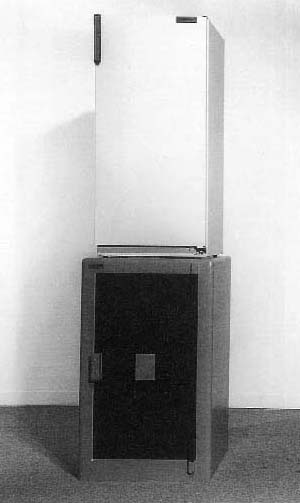
In the back room things are more complicated: twenty units positioned in a grid–like arrangement on the floor. Some test mainly binary combinations of unorthodox materials like clay and branches, polystyrene and cardboard, rock and paint, plaster and foil, wire and tape etc. Others investigate just what plinths might be; much like the French artist Bertrand Lavier who has done peculiar (but brilliant) things like placing a fridge upon a safe. Still others explore patterns of painted marks on odd materials and constructed Picassoesque ceramics. Others yet try transitive verb actions with materials, the ideas embodied in Richard Serra’s verb list for example, using processes like gravity or decay. Little bricks that have tumbled off the seat of a toppled chair. Clay blocks in a pile, some of which have been crumbled, or diminished in scale.

The result is a fascinating floor display that has energy and intelligence, is visually intriguing, and a great contast to the calm and quiet of the front room. An exceptionally good exhibition at George Fraser. A knock-out.

Auckland permutation


Julia Morison: Myriorama
Two Rooms
3 July - 9 August 2008


At Two Rooms Julia Morison presents a second permutation of her newest project, Myriorama, the first being in April at 64zero3 in Christchurch. The title refers to a Victorian picture-card game where a landscape has eighteen components that can be recomposed in a line with a continuous horizon. With seemingly infinite possibilities. Morison can create at least eighteen sorts of repeatable panel. These can be recombined according to the needs of each gallery space.

In Christchurch the work in one room was linked up to form two looping, twisting fat worms, with nodding dancing heads. These were joined on several walls continuously.

Now in Two Rooms’ upstairs gallery, Morison has gone for discrete units that look like flattened cylinders, featuring pinstripes that contain configurations like Celtic/Nordic motifs or slip knots – inserted in different sizes. The colours are delicate blues, greys or cream with a mottled feathery texture –the result of thin ink being applied over gesso. There are also shiny black Perspex panels inserted into the forms.

Compared to her other recent projects, these works are formally simple and restrained: unlike say the wild and decorative extravagance of Gargantua’s Petticoat with its flailing arabesque tendrils. These are subtle spatial teasers where flat shapes can quickly pop into convexly moulded plasticity, and forms that travel around corners suddenly resolve into cohesive spatial masses. The work has tension and verve where she has taken the implications of the edges and flat shapes and contradicted them with wilfully independent internal configurations and linear alignments.

Morison’s Myriorama paintings place intriguing pressures on the rooms they occupy, such as this narrow gallery with its sloping roof and long proportions. They are an unusual combination of formal ornamentation with the shrewd manipulation of a bodily confining space, one that usually shows framed rectangular works. A memorable and exciting treatment for a space that is normally difficult for installational sensibilities. In September Myriorama appears as a third variation in RAMP in Hamilton. There will also be a fourth one in Tauranga.

(With the above photographic images digital technology, one discovers, cannot cope with parallel lines, forming strange moire effects. As I've said, the lines are parallel.)

Tuesday, July 22, 2008

Visually simple, mentally complex


Michael Harrison: Example of the Ravens
Ivan Anthony
16 July - 9 August 2008

Some artists are never totally committed to a completion of a work, even if the item in question has been signed or exhibited. Even if a collector has purchased it and installed it in their home, they still might call round and just add (or remove) a little something. The work is never far from their thoughts, especially if it is owned by a friend or somebody who lives close by.

The artist once known as Merylyn Tweedie used to be famous for occasionally changing collages that collector friends owned. And in this show at Ivan Anthony’s are several Michael Harrison paintings that have been shown in earlier stages years ago, but now are different. He obviously hasn’t wanted to let go. To forget them and walk away.

There are nine acrylic works on paper in Example of the Ravens, all looking unnervingly like watercolour but not. I used to only prefer the Harrison works that focussed on positive/negative shape relationships – a carry-over from my deep affection for Gordon Walters paintings - but now I’ve changed. I’ve grown fond of his other stuff too.

Harrison’s images exude incredible sensitivity, by virtue of their ultra-delicate washes of very thin colour, faint pencil lines and precise placement of symbolic images. That can be a drawback. Like Reichsmarschall Gōring who once said "Whenever I hear the word ‘Culture’ I want to reach for my revolver,” one can sometimes bristle at too much sensitivity. It can be cloying, and make you long for something raucous and deliciously vulgar. A fistful of salt chucked into the bowl of sugar.

These works are incredibly romantic in the way they depict women. As images of besotted adoration they intrigue because of a sense of worship that seems Victorian. Yet Harrison (thank God) is more complicated than that. Hints of sarcasm and mistrust creep in.

Enlist shows a man saluting his overbearing, controlling lover, trying to figure out how to break free. Prediction has another fellow contemplating the dynamics of his relationship, represented by an embracing couple in the sky. They are enclosed in a silhouette that could be a woman’s head with long hair and flouncing curls. It also could be a skull and crossbones. Crows and a leopard-faced gargoyle hover ominously nearby.

Such images of healthy cynicism keep Harrison’s work fresh and not soppy like it might at first seem. His use of soft greys and mottled blues bring a discreetly moody atmosphere to his practice. Images on your computer screen won’t capture it though. You need to see these works directly in the gallery to enjoy their intimate scale and painted surface.

Monday, July 21, 2008

Collective minds


The Swarm: a peek into the hive-mind of group dynamics
Curated by Andrew Clifford
Gus Fisher
11 July -16 August 2008

Here is a juicy question:

When you assess a show, how much of it is from analysing the overarching curatorial premise (if that is stated), and the relationship of the ingredients to that – and how much is dependent on the quality of the individual items, regardless of curatorial intent?

After all, a viewer can ignore the intention of a curator if they wish, or the artist, or both – and the curator can ignore the artist (and maybe viewer) too. The axiom ‘Trust the art, not the artist’ is pretty sound commonsense if you believe art should have its own internal logic and independent semiotic life, most of it accessible visually. Perhaps the creator is the last person to ask about an artwork. There are likely to be unconscious components clear to outsiders that the artist is blissfully unaware of, and things that the artist thinks are glaringly obvious, which somehow, have mysteriously evaporated.

Okay, back to curatorial premises, as with this show. Some of the work supports Andrew Clifford’s interest in ‘a group infrastructure that wields more power than the some of the parts’ and some of it doesn’t. He references films like The Birds and The Swarm where wild creatures decide to organise themselves against humans.

When he succeeds in presenting a case for his premise, Clifford’s choices are brilliant. The music is very clever as a source of persuasion. From Scratch’s recording of Gung Ho, and Clifford’s discussion of Phil Dadson’s interest in hocketting (overlapping melodic phrases or rhythms from different sources) is fascinating - as is Douglas Bagnall’s Music Industry Simulator, which breaks down into formulae the melody structures of pop tunes to make them reconstitutable into ‘originals’ like building blocks. Also very witty in this context is Ani O’Neill’s collection of communally made, woollen knitted circles that could also be colourful bacterial colonies.

Not so ambiguous, but perfectly apt nonetheless, are Gregory Bennett’s sci-fi videos and images of thousands of little naked men, scampering in an unleashed tide through buildings. Louise Fong’s 1995 painting Cluster, with its satellite paintings encircling a central ‘mother’ canvas, is also an extremely clever element picked by Clifford.

With the other works, I felt they were dominated by too many different ‘atomic particles’ rather than ‘linkable’ elements that had a commonality. The art that depicted insects, that of Richard Killeen and Elizabeth Thomson, seemed to present too varied a range of species to suggest the existence of a communal mind. And Matt Molloy’s rickety bookcase of Christine Hellyarlike plaster and latex casts of egg-covered surfaces again seemed too unfocussed in content to fit the theme.

Now, as I suggested earlier, you could say ‘bollocks’ to the curator and just enjoy the show for its separate individual items, forgetting the theme. We all know that even one work, if it really excites us, is worth a visit to an otherwise tedious exhibition.

Rest assured there is nothing tedious here. There’s plenty to enjoy. Plenty of engaging parts for only a partially resolved whole. That doesn’t really matter, for it’s really an excuse to put some stimulating art out for an audience that might enjoy it. And they will. Nothing wrong with that.

(Above images from Richard Killeen, Ani O'Neill and Gregory Bennett.)

Friday, July 18, 2008

Stuart Page and Artandmylife comment on

Shustak and Celebrating Abstraction.And Tao Wells still has more thoughts on Forget Art.

Thursday, July 17, 2008

Celebrating Abstraction


New Vision: the New Vision Gallery 1965 -76
Curated by Joanna Trezise
Gus Fisher
11 July - 16 August 2008

New Vision was one of the very first dealer galleries in this country, and this sampler of key works that they (the proprietors, Dutch immigrants Kees and Tine Hos) sold is pretty impressive. In fact there are no fizzers anywhere. It’s well put together in terms of chosen works.

The trouble is the GF gallery space is distracting with its marble floor and ornamental doors, and there is too much work. The three components of painting, ceramics and works on paper would be better presented in three separate rooms. The space is far too crowded.

What I’m saying here though opposes the Bauhaus ethos that New Vision upheld, of not separating craft and art. Total anathema. The issue would be further convoluted if sculpture were included too.

Nevertheless this is a good show to visit if you want to see Phil Clairmont at his tightest and very best. There is also a gorgeously minimal Don Driver, two extraordinary Gordon Walters koru paintings (one ochre!), and a lovely horizontal Milan Mrkusich with three large circular Jungian symbols. The Louise Henderson triptych and Rudi Gopas are likewise impressive.

Of course this is a history show, but these works still live and breathe. There is lots of juice left in them yet. Particularly the paintings.

Wednesday, July 16, 2008

Impressive sound


Ryoji Ikeda: data.tron.2007
MIC Toi Rerehiko
11 July - 15 August 2008

This installation is not the first time Ryoji Ikeda has presented work in Auckland, but it is the first with visual material. In 2001 he provided sound compositions for Toyo Ito’s Blurring Architecture, a memorable show at ARTSPACE that NZ architect Andrew Barrie organised.

Here in the MIC, it is his sound that dominates – so crisp, razor-sharp, intricate and penetrating that it causes the visual image component to seem comparatively dull.

Ikeda works with rows of data that he transmutes into sound and image and projects at a frenetic rate four times faster than film. Yet despite the use of deep receding perspective and rapidly rising and descending columns of digits, you are not drawn in. It is only on one wall. The immersive sound though encompasses you. Your body tingles as swirling aural sensations snap, crackle and pop their way into your skull. Their staccatoed, vibrating sonic stutters are what you remember.

Tuesday, July 15, 2008

Shustak


Stuart Page: Shustak
MIC Toi Rerehiko
11 July -15 August 2008

Larence Shustak was a photography lecturer at Ilam art school while I was a painting student there in the early seventies, and much loved by many of my friends. He came to Christchurch after working in the sixties for Life magazine, doing important documentary projects such as for the New York Jazz label Riverside Records (see the one of Monk above), and making a handful of short documentary films. Much of his work deals with the gritty realities of life in East (Greenwich) Village and engages with communities like handicapped children, or the black Jews of Harlem.

Shustak was a gregarious, big-hearted American who liked to talk about art (a category in which EVERYTHING was included), make images, play his banjo and smoke grass. My impression though was he had toked on one ‘j’ too many and lost a lot of brain cells. A lovely warm man, but hardly what I would call ‘wise’. I imagine others (like Stuart Page who here presents samples from his documentary on Shustak and a curated selection of Shustak’s photographs and short films) will vehemently disagree.

Page’s trailer for his film is extremely informative, but only about 20 minutes long. It is a shame MIC just don’t have continuous screenings of the full 90 minute doco. (After all some of the German videos recently shown at St Paul St were almost that long and people came and went at will.)

I met Shustak several times, know many of the people in the film and am more than a little puzzled. It would be good to get a fuller grasp of what he was on about as a teacher. Many of his black and white photographs were very eclectic – Brandt, Brassai especially – but his jazz portraits are wonderful. Shustak is obviously very highly rated by his peers in the States, and seeing a proper full length documentary would hopefully reveal a great deal. In the meantime there is an excellent (albeit a little worshipful) essay by James Robertson in the free takeaway poster/catalogue.

Sunday, July 13, 2008

Recycled stamps


Lianne Edwards: Recollect
Vavasour Godkin
3 July - 2 August 2008

At Vavasour Godkin, Nelson artist Lianne Edwards is having her first solo exhibition, presenting thirteen grids made of parts of dissected used stamps (some over 70 years old) interconnected using slivers of transparent hinges. Most sheets are suspended from the walls using strategically positioned pins. A couple are framed under glass in deep trays.

Edwards is attracted to certain parts (or possibilities of shape) within each stamp’s image. She cuts out many examples and positions them in fragile square or hexagonal formations. She also makes star configurations, wheel patterns, and wonky cross-shaped structures. The removed images can all be the same way up, or top and tails, or with sideways variations. Birds, mammals, ships, aircraft, houses, ancestral symbols: anything can be painstakingly extricated from the original stamps and arranged into these delicate and frail grids.

This sort of labour intensive art raises all sorts of questions. Just because something is time consuming to make or superbly crafted doesn’t mean it is interesting. Yet the converse happens to be true too. Something can be roughly made, even awkwardly thrown together, and the idea still make it work. I think this is because seductive beauty and grating ugliness can become interchangeable when a compelling concept totally intrigues. Something initially repulsive can be mentally transmuted into elegance if propelled by the right idea.

I know. I’ve digressed and done an odd little rant – the reason being there are interesting aspects about these paper grids beyond the artist’s obsessiveness and skill with a scalpel. Their repetition says something about species and types.

Like Warhol’s silkscreened coke bottles of the sixties, each unit is an individual. Some stamp parts have strange watermarks or discolorations. Collectively from a distance they look like coloured lace. And like an animal group on the verge of extinction, these grids are at the mercy of fate - for the smallest draught might dislodge them off the wall. Even when framed under glass they look vulnerable and fleeting, as if in an interim state, a stage of transitory suspension.

Friday, July 11, 2008

Flickers of comic anxiety


Peter Stichbury: The Alumni
Curated by Emma Bugden
Te Tuhi, Pakuranga
12 July - 21 September 2008

On an intuitive bodily level, there is no more immediately compelling image to the human gaze than another human being’s face. Even a belligerent misanthrope will instinctively seek out an ordered semblance of a visage’s vital components – eyes, nose, mouth – when confronted with ambiguous stimulatory images. But such subject matter for artists is ancient, so it is a substantial challenge for contemporary artists like Stichbury to make it fresh for new audiences. Yet few works here are based on real people whom the artist knows. Most of the portraits here are fictitious creations, hybrids of magazine or online images blended with shots of friends and family, with titles and identities constructed as well.

Te Tuhi, with its four connected galleries, is a perfect space for Bugden’s assembled collection of Stichbury’s work, and amenable for the orchestration of a powerful visitor experience. Stichbury’s visages are extremely precise graphic renditions with ultra-fine detail. They work well in groups where they become families or coteries. Varying between illustration and caricature, and blending the maudlin with the gut-shakingly comical, they avoid the devastatingly tragic or the truly vicious. This is wry humour, a gentle kidding.

In a show like this, with a lot to compare, you become conscious of Stichbury’s mannerisms: lots of blonde babes with huge bambi-like eyes and triangular mantis heads, with glistening irises and moistened lips. Some are frontal, other three-quarter view; some at eye-height, others slightly below.

The most realistic faces are on bowling balls. Here the artist has curtailed his impulse to distort because painting on a sphere will do that spatially. For all his images of delectable women they exude very little individuality. The most strikingly personable images are of men. Stichbury excels at male character studies, whereas women become abstractions of hetero male desire. This is magazine and movie culture where make-up and hairstyles are set strictly within glamour templates. Femmes and dudes rule the roost. There are no effeminate men or butch women.

The most recent works are the flatter more graphic images, not the plasticised sculptured heads that look so solid and super-intense. Stichbury's earlier images are more connected to digital animation whereas the latter ones seem to be out of graphic novels or comics. It is fun to study his methods of cropping and experiments with scale to see how they affect the psychological impact of each facial expression. Stichbury’s titles and Bugden’s wall labels (based on conversations with the artist) weave imaginary narratives around personalities constructed to accompany the faces, but that, though clever, overdetermines the reader’s interpretations. It is attempting to further enrich already extremely layered work. It just semantically clogs up images that are already easily sufficiently engrossing.

It is interesting to compare Stichbury with the photographer Yvonne Todd. Both construct elaborate names for the characters they create and depict, but Tood is about desperate control of emotion, whereas Stichbury renders fleeting expressions that rapidly flicker across his subjects’ faces during periods of intense anxiety. Stichbury’s Swoon (Stendhal Syndrome) (see top) on the poster is ostensibly about over-identification with an artwork in a gallery, but in reality is more about a growing realization of horror. Perhaps it is both, about the dangers of art and its power to transform (or corrupt) the mental life of its viewer.

Thursday, July 10, 2008

Changing Fraser


Jacqueline Fraser: Topless (The Hustler and Superstars)
Michael Lett
9 July - 9 August 2008

Looking at this show, the title work (at the top) is obviously a key ingredient. It seems to be telling us where this artist is heading now, for a global political sensibility is breaking into the privileged pampered hermeticism she is famous for satirising, bringing with it a sense of the filmic – a hint of the sixties French ‘new wave’.

Fraser seems to be getting sick of bored unhappy party girls and their fashion obsessed lifestyle. Her large sculptural collages are moving away from Warhol as inspiration towards (for example) Don Driver and his obsessions. More than Driver’s skin/hair fetish / collage is involved though. While introducing a dramatic use of black and white with torn paper edges, and occasional swathes of mushy grey paint, she is also letting delicate nuances of photographed outdoor colour creep in to replace the wham bam/thank you ma’m garish fabrics. One can almost taste the cool fresh air (admittedly with a whiff of Louise Lawler ‘Nam cordite mixed in). Perversely the hooded black pimps and their bronzed white bitches are ushering in a new beyond.

However there is still plenty of the old one here too, with its magazine baby doll pouts and beribboned pooches - alongside synthetic wigs, chiffon dresses and bridal veils. It all impresses. Drenched in the sarcasm of Fraser’s over-wrought catty titles.

Many people are talking of a new optimism and political awareness present in the States right now (where Fraser lives), reflecting hopes of Barrack Obama’s election. And this has been understood as being part of the Whitney Biennial too. It is part of that same buoyant mood that seems apparent in the newer content of Fraser’s work. The drug-addled, paranoid, claustrophobic subject-matter is starting to disappear.

Wednesday, July 9, 2008

More barricades


Charles Ninow: Effective Campaign Heroics
Curated by Ash Kilmartin
Window gallery, Auckland University Library entrance
July 9 – July 26 2008

Charles Ninow’s Window exhibition seems to reference Dane Mitchell’s Barricades exhibition at Starkwhite last year (and a little Daniel Malone thrown in as well) - such are its allusions to street barriers and Molotov Cocktails (see online video). The display consists of the glass space loaded up with dozens of paper posters folded into paper bags and filled with air. A cynical comment on revolutionary rhetoric perhaps, especially as barricades are usually made of sandbags (and a photo of some is on the webpage). Air filled bags may be good for bluffing at a distance, but they aren’t going to block bullets or tanks.

The same sarcasm seems prevalent in the video. Shaking a SUMMIT ginger beer bottle with a breadknife in it references petrol bombs, spray paint, and hoons spraying each other with beer. The results though, are only a lot of rattly noise. When the knife slips out to fall on the floor it is termed a ‘breakthrough’. Such spillages happen six times.

The online video and gallery display seem calculatedly vacuous. The latter has a European look about it, especially that of the great French artist Arman, who in the early sixties filled vitrines with consumer items, and sometimes dry rubbish. Just as Piero Manzoni canned and sold his own shit, Ninow with his fake Arman, seems to be provocatively marketing ‘hot air’ as ‘political’ content. Deliberately insubstantial - and adroitly droll at that.

Wallpapering the treetops


Kevin Appel
Two Rooms
3 July - 9 August 2008

Kevin Appel is a Los Angeles artist who recently did a residency at Two Rooms, and so this is his first New Zealand show: one of eleven collages and five large paintings.

The paintings are architectural fantasies riffing off the decorative properties of synthetic cubism. Extremely pristine and lovingly crafted, he has emulated the compositional placements of his smaller collaged studies to provide a chromatically controlled assortment of wallpapers, fabrics and faked woodgrains that also read as shambolic houses nestling in the lofty branches of trees.

They are an orchestration of patterned planes, drawn but squashed pyramids and the occasional jutting breast, all trying to pull free of each other, but restrained by taut contour lines that function like guy ropes on a tent in a gale. The smaller paintings are more horizontally and vertically aligned, with plenty of white space at the edges to put pressure on the centre. They tend to be stable whereas the larger works have less discernable structure, with more tumbling movement and looser diagonal tensions rolling out towards the peripheries.

Oddly Appel’s more graphic, linear studies are much more spatial. You are not so conscious of the picture plane. The loosely assembled wallpaper shelters are easier to discern while also being more exuberant with hotter colour and irregular pattern. Their delicate pencil grids are teetering, fragile and exquisitely poised.

Even though the paintings are about tautness, and use tweaked but strident dynamics of interlocking shape to delineate the space, some of the collages using more marker pen and less pencil are wildly spontaneous. They seem to reference Philip Guston’s smoking heads and Archimboldo’s librarian head made of books, and have an abandoned freedom away from anal precision and obsessive craft. Surprisingly such bodily drawings celebrate relinquishing control and letting the hand move with less thinking. They laud the clunky, raw and unprecious.

Monday, July 7, 2008

Brownian motion


Kentaro Yamada and Jamie Kydd: Eye Drops from Upstairs
New Call, Auckland
June 24 - 17 July 2008

Yamada and Kydd’s installation is in two parts. Two separate works.

One is a row of three goldfish bowls on plinths, with three reading lamps bent over, containing tiny cameras. Within each bowl glows water and a fish, and underneath the bowls are movement sensors connected to a sonar programme. Nearby on the floor are three small screens, with the rectangles divided into four - each quarter a circular variation in subtle colour that provides a different quality of ‘aura’, recording very recent movement.

Yet the fish don't really move around much. Just huddle under the devices that oxygenate the water. They reluctantly create a musical performance in the dark room, and you feel you might be underwater yourself. Maybe in a submarine. If you are inclined to be a trifle participatory, moving your hands under the bright lights affects the pitch of the three beeping ‘instruments’.

The other work is like a brazier with a flue above it – akin to a searchlight with a faint beam aimed upwards. The heat is very low but sufficient to cause spasmodic particles of dust to ascend in the vertical stream. Like the fish work, chance plays a big role.

Both gentle, understated pieces rely on a viewer presence to activate the dust and disturb the fish, just by walking around. Probably the more visitors present at any one time, the more ‘sparks’ zigzag in the faint light and the more the sonar beeps vary. Good reason to take a couple of friends when you visit.

Sunday, July 6, 2008

Lilith Cohen's comment on

Goosestepping through the whorehouse and David Cross' article on the Sydney Biennale.
Thank you both.

Saturday, July 5, 2008

Sweet crudity


Erica von Zon
Starkwhite
30 June - 26 July 2008


This small installation, in one of the upstairs rooms at Starkwhite, deals with various cultural activities that help us escape from the prosaic humdrum: diversions such as tourism, music, art exhibitions, films, collecting bric-a-brac, etc. Von Zon has created an amateur craft stall that looks like residue from a performance. Like a mini-brocante it presents two trestles of fired clay animals, exotic tropical birds and knick-knacks like Turkish minarets, along with a wall of posters. There are also some fake sausages and sawdust in small sacks, a pretend tool-rack, and bags of tape, polystyrene bones and paper leaves.

The making of these items shows a disregard for the conventions of polish and finesse. It disdains manual skill so everything is extremely casual, rough as guts. Yet somehow with the crude ceramics a sort of charm creeps in, especially with the cat-headed bowls with their lumpy pinched forms. In contrast the posters on thin paper are raw, slap dash too. But no sweetness. Just rough.

Strangely overall, for such an installation, the arranged props are not consistent. The combination of immaculate, ’sterile’ trestles (with no handcrafted, draped covers) with touchy-feely tactility doesn’t seem calculated, as it might - only negligent. Though the inclusion of tools and tape in canvas pockets hanging on the wall suggests a process is being worked through, that is misleading. The work doesn’t seem to be about any ongoing testing of materials or subject-matters.

However in discussing von Zon’s performance work, the Te Tuhi website says her practice is about fakery. Maybe that can apply here too, but crude representation as a visual style doesn’t necessarily equate with trickery. It could just as easily be ‘authentic’ or ‘sincere’. Either way the work looks half-hearted and unfinished.

Friday, July 4, 2008

Square eyes, round minds?


Wolfram Hahn: Disenchanted
Starkwhite
30 June - 26 July 2008

This collection of photographs is unusual because it makes us think about two things. Firstly, the notion of ‘childhood’ and how children are perceived by older people. Secondly, the hypnotic power that television has over the minds of children.

When do children’s facial expressions become ‘childlike’ and when do they seem ‘adult’? What are our preconceptions of what the essence of these states might be? In this country we tend to have our children wear clothes that are created specifically for ‘kids’ to have fun in, but in Europe children are more often presented in public by their parents as mini-adults. They are dressed as miniature versions of Mummy and Daddy, as scaled down adults in formal attire – not kitted out for recreation. Kiwis, I think, tend to treat children as individuals who are not replicating their parents and often worry that they aren’t enjoying their innocence, believing that ‘adulthood’ should be deferred, that the responsibilities of later life should be delayed as long as possible.

To our eyes, the German children watching television in Hahn’s exhibition look older than their years. They have an intense concentrated gaze, being unbelievably serious while absorbed in the stories being unfolded before them. They wear casual garments, their hair is often untidy and not groomed. Their eyes are focused on a screen below the camera, and a bluish grey reflected light on the walls behind them brings out the warm colour of their faces and clothing. They are utterly immersed in the medium, without distance – forgetting themselves as observers.

Is all this a bad thing? I (personally) hate television - but I don’t think this exhibition necessarily endorses my prejudices. I hate it because I feel the programming insults me, so I spend my evenings with better recreational activities. However, maybe children learn a lot of good things from this medium. This show seems to be intended as a critique of television but I don’t think that is evident from the images. If you read bedtime stories to these children they may well have the same look.

Thursday, July 3, 2008

Down the gurgler?


Sara Hughes: Scales of Economy
Gow Langsford
1 - 25 July 2008

In this show Sara Hughes mixes op-art abstraction with digits showing fiscal worth. Financial figures become the repeatable unit she stretches and distorts like the ‘skins’ of Riley or Vasarely, rendering them in buoyant lolly-pop colours.

Exuberant though her palette may be, Hughes’ use of numbers is intended to refer to the American economic crisis as it occurred while she was living there last year. On another level these square canvases also seem to allude to her own anxieties about the market for her paintings. Some images seem to be of spirals like the striations that line the barrel of a gun. Others are tunnel-like, with receding formations of concentric circles, tucked inside each other with diminishing number size. Others still are like looking down the plughole of a sink, with swirling numbers rendered in foreshortened perspective. Almost all digits seem to moving away from the viewer, not advancing towards them.

Some vertical rectangular paintings, which refer to stock exchanges, use horizontal compositional formats, not circular. Their images are like strips of ticker tape recording triplets of zeros, spaced apart through commas as if part of a continually growing, massive possibly infinite number - with a beginning which has been long lost.

A third type of canvas is a horizontal rectangle with records of bids at an auction, coloured discs like price tags hanging in clusters showing decreasing sale prices. Other paintings avoid canvas and numbers altogether. They consist of price labels dipped in paint (red for a sale), held in circular configurations by magnets fixed to the wall. One looks like a torpedo being fired out of a tube towards the viewer – reflecting perhaps Pat Hanly’s famous muttered remark about speculating, profit-hungry buyers, that he hoped the paintings would fall on their heads and kill them. The price tags are also a pun on the 'scales' of the show's title.

This is an interesting theme for Hughes to explore, with her colour choices determined to some extent by popular selling conventions. Her work here is hampered though by such colour choices, which with a white background make the painting ingratiatingly decorative. She seems not an explorer of closely related chromatic or tonal properties, but more interested in shape than hue. If Hughes continues with the fiscal theme as a serious matter for investigation, she may find painting too restrictive. It should be fun to watch where it leads her.

More aural than visual


Tony Oursler: Spectar
Jensen Gallery
1 July - 26 July 2008


Like his friend and fellow musician Mike Kelley, Tony Oursler was taught by John Baldessari. There is an element of Baldessari’s ‘Learn to Dream’ billboard in this trio of works just opened at Jensen, for Oursler is very interested in the imagination.With that comes mental states and the paranormal – the sort of subject matter Olivia Plender researched in AAG’s Mystic Truths with her interest in Victorian mediums like the Fox sisters.

The first of the three works is Void/Void, a black aluminium blob that looks like spilt ink, with a distorted mouth quietly muttering a monologue out of a wobbly aperture in the middle. It looks related to one of the Painting + Paper: Ooze series from last year.

Spectar is the star of the show, but not seen at its best because there is too much light in the gallery space. The plaster-over-polystyrene form on which several evil looking eyes and one vertical mouth are projected, looks like a Barbara Hepworth or Joan Miro sculpture. It has a terrific verbal soundtrack containing lots of references to séances and table tapping, with at least two voices talking at once, and a really varied orchestration of vocal tone, from smooth growling to being startled or interrupted. The voiceover could even work by itself.

On his website there is a conversation between Oursler and Parkett editor Louise Neri where he talks about paring down some of his older works. Incandescence used to be a talking lamppost (I saw it in Munster in 1997) but in this new version instead of a tall city street lamp flickering on and off and synchronised with the spoken text, we see a domestic bulb. The absurdity is lost with the diminished scale and loss of public space. Like Bruce Nauman, Jenny Holzer, or Mike Kelley, Oursler is an accomplished writer, but this text needs more theatrical visual material with it, and its aural qualities quickly become flat.

Although there only three works you could spend a lot of time with this show, concentrating on the spoken word. Opportunities to experience Oursler exhibitions in Aotearoa are rare, so don’t miss it.

Wednesday, July 2, 2008

Baldessari Billboard


John Baldessari
ARTSPACE Billboard
Langham Hotel Carpark


This is the third ARTSPACE commissioned billboard on Langham’s Karangahape Rd site, and probably the most successful so far, simply because the length of the caption makes stunning use of the 22.5 x 4 m. size and ratio. John Baldessari, the renowned LA based conceptual artist and teacher, has created a phrase celebrating the imagination (LEARN TO DREAM). It perfectly fits the exceptional length of the low-slung hoarding.

The duck-egg blue letters showcase an unusual font (Churchward Montezuma 96 Extra Bold) designed by Samoan New Zealander Joseph Churchward. Peeking through a black background, it reflects the optimism of the text. The composition has a peculiar symmetry, two five lettered words separated by two letters (TO) in the centre, with EAR balanced by REA. The O is unusual because it is not unusual. It has no indentations or swellings like the other letters.

Churchward’s font is the real star of this image, its strange bulging curves giving the letters distended protruding stomachs so that with the chunky serifs, there is an unexpected folksy humour in the appearance of the language.

Baldessari is chiefly known for his amusing photographs and sixties text paintings - though his range of assorted projects over the last forty years is astonishing. Through Baldessari’s involvement with this massive hoarding, Brian Butler, ARTSPACE’s director, has brought some international public art to the city. And Churchward’s typeface to a new audience.

Tuesday, July 1, 2008

Ranking the Biennale (a contribution from Wellington artist and educator David Cross)


The 16th Biennale of Sydney: Revolutions – Forms That Turn
Directed by Caroline Christov-Bakargiev
17 June – September 7 2008

I long ago gave up ranking Sydney Biennales. Having been to ten of the past eleven they do begin to bleed over time into a continuum. Often it seems the Biennale is marked more by the constant passage from Artspace to the MCA, to the Art Gallery of New South Wales to whatever alternative behemoth venue the artistic director can wangle in a given year, than by captivating holistic events. You remember the good ones and the bad ones but struggle to remember even the vaguest details of the nascently mediocre ones.

Revolutions - Forms that Turn benefits enormously from coming after two worthy but largely tepid Biennales. It would be fair to say it is a good Biennale, very good even. Indeed so well received has it been that I am yet to come across a naysayer who has poured scorn on the event. This counts for little though as you know that a solid section of the cognoscenti will be scouring the blind spots and working over the rougher curatorial edges in search of the gasping contradiction or oversight. The Sydney ‘banale’ as one colleague in Australia has deemed it will always been fair game for those irascible critics uncomfortable by the sheer massness of the event.

It will be interesting to see where the searchlights penetrate Caroline Christov-Bakargiev’s installment, as this is a well-considered Biennale that holds together both as an idea and as a suite of engaging contemporary artwork. Leaving aside the title, which one hopes is not employed literally - if it is, it’s risible - and concentrating on the work, there is a lot to unfold and contemplate.

A stated aim of this instalment is to contextualise radical aesthetic innovation over the last hundred years, linking Rodchenko with Tinguely, through to Fischli and Weiss. It’s an ambitious attempt (more than 150 artists) to construct a platform from which to locate a particular strand of politicised contemporary art. The big themes are conceptual art, performance, arte povera and situationism and they serve as critical ciphers from which we might approach the work of artists like Javier Tellez, Jeremy Deller, Susan Philipsz and Simon Denny.

Sometimes the recent examples seemed to be overshadowed by this alignment, with works by Shaun Gladwell and Paul Pfeiffer offering a ‘feel good’ sensibility but lacking the necessary bite. This was made clear by the potent offering of Mark Boulos, whose duel video projection work All That is Solid Melts into Air was a devastating meditation on the Nigerian oil industry and the disaffected dissidents attempting to secure, by any means possible, some of its booty. Other video work by Deller and Tellez was equally impressive in linking nuanced critique with documentary modes.

Special mention should be made of Mike Parr’s retrospective within a biennale, which was exceptionally compelling. In a very dishevelled building on Cockatoo Island, Parr restaged footage from earlier performances in rooms that stank of piss and worse. The site responsive aspect offered up new ways of thinking about his extraordinary body of work which seems fresher and more relevant than the escapades of the better known Chris Burden, also seen in the exhibition. There were clangers as always but the Biennale succeeded in building a context for a specific kind of contemporary practice that moved the experience well away from the banalities of the art supermarket.

(The 5 images are - top to bottom - of works by aiPotu (Andreas Siqueland / Anders Kjellesvik), Anawana Haloba, Tamy Ben-Tor, Vernon Ah Kee, and Rosemary Laing.)