Nau mai, haere mai, welcome to eyeCONTACT, a forum built to encourage art reviews and critical discussion about the visual culture of Aotearoa New Zealand. I'm John Hurrell its editor, a New Zealand writer, artist and curator. While Creative New Zealand and other supporters are generously paying me and other contributors to review exhibitions over the following year, all expressed opinions are entirely our own.
Showing posts with label Denys Watkins. Show all posts

Wednesday, October 21, 2009

Bath St. dip


Group show: New works
Bath St
23 September - 31 October 2009

Sixteen new artworks from eight artists associated with this gallery, provide the body of this Bath street exhibition. The show seems a little under-nourished, but these ten items (from five of the contributors) made the visit worthwhile for me.

Some of the works make corny puns about the gallery name, but succeed nevertheless. Peter Gibson-Smith’s pencil drawing covered with what seems to be wax shows a three colonial gentlemen bathing in the geothermal waters of the Pink and White Terraces. It looks like a digital work with its regular hatching, but the transparent coating seems to be a conceptual metaphor referencing the 1886 Tarawera eruption that is depicted in the background and of which the subjects are blissfully unaware.

Tom Sladden has a swimming pool included with a podium and harbour mouth in three deliberately ‘unfinished’ paintings, rendered on wooden panels. They exert a fascination through the fact that pieces of drawn or painted-upon paper can be added to their surfaces, as evident from the detectable remnants of double-sided tape. The viewer is forced to mentally envisage alternative possibilities for these ‘empty’ images.

This interest in process continues in four works by Tanja Nola that examine the chemical constituents that underpin not only traditional photography but also metal and glass casting, and grinding and polishing. One is an image that takes five years to be completed, the three others being sculptures with casting crystal as the central component. Despite examining various craft methodologies these seem surprisingly surreal (even Dali-esque) - though Nola has a history of such a sensibility in her photography – and an intriguing cross-disciplinary hybrid.

Louise Purvis exhibits wall sculptures that are fibreglass models of topographic maps, covered with flock. She takes an essentially horizontal method of spatial representation and turns it into a vertical wall relief, and then wittily covers it with a wallpaper material in an unexpected act of self-mockery - as if she half wants to hide it. There is an peculiar unresolved conflict going on, for the flock could also be coloured grass.

The highlight is an amusing Denys Watkins portrait of Pluto the Disney dog painting a picture. He is holding it with one ear, while having a brush tied to his tail. The image is ambiguous, for the camouflage-coloured hound is also standing on a table. He appears to be looking out a window/painting, as if trying to escape. Watkins could be commenting on the sometimes claustrophobic nature of art, or he might be saying the opposite, that it is our salvation, that as a form of fantasy it rescues artists from the tedium of everyday living.

Wednesday, December 10, 2008

Twenty-three in the Bath


Group Show: December exhibition
Bath St
2 December - 20 December 2008

Christmas stock shows, whilst they can be irritatingly trivial if the works seem like dinky trinkets, are also a good way to surveying a gallery proprietor’s taste. They give you a chance to see if there is a pattern or consistency. What makes them tick? What aesthetically or conceptually pushes their buttons? They might even avoid consistency.

This Bath St show is spread out on the walls of the large L-shaped room so the twenty-three artists don’t get in each other’s way. Even small sculpture is on the walls.

A cursory glance indicates that there are some formal and stylistic groupings that link some of the artists and works together. Circular wheel forms – for example - are found in Louise Purvis and Robert Jahnke works. In painting also, overlapping and undulating net forms are seen in Katie Thomas and Kathryn Stevens. Or pressuring shape with contour-edge or line in Leon van den Eijkel and James Ross.

If I could scurry into the gallery in the dead of night with a suitcase and help myself, the works I’d pinch would be the gorgeous Denys Watkins’ Indian works on paper and Katie Thomas’ two fascinating ‘net’ paintings. And I’d probably risk a hernia by also grabbing Bob Jahnke’s wonderful 'crayfish pot' made of corten steel.

I’d be tempted by the several mesmerising drawing/photographic hybrids in this show: works of ink on photographs by James Robinson (for him subdued and restrained); a photochemical drawing by Grant Beran; and surrealist photographs by Tanja Nola.

There is plenty to think about here. Peter Gibson Smith’s shaped panels use intersecting planes in a manner related to the drawings of Georgie Hill (at Ivan Anthony), but with a delicate scrubbed coloration that avoids intensity, using modelled forms, not negative shapes.

There are also Anna Eggert’s intriguing sets of common objects covered by wound-on data cable. The effect of repeated tiny horizontal lines creates shifting moirelike patterns, unpredictable rhythms and curious optical blendings.

Eggert is an Australian artist, as is Jonathan Jones, previously shown here in the Jim Vivieaere curated exhibition Good Company Flash Lights. He now presents shelves holding wiping sponges. On these he has placed aboriginal motifs that look like bark painting patterns, and which also seem connected to Jasper Johns’ famous ‘flagstone’ paintings. The sponge serves perhaps as a clever post-colonial metaphor, the wiping away of one culture maybe to superimpose another.

This is a good exhibition to leisurely ponder over. It has an enjoyable diversity.

Descending from top to bottom, images are of works by Katie Thomas, Robert Jahnke, James Robinson, Tanja Nola, Peter Gibson Smith, Anna Eggert and Jonathan Jones.

Thursday, July 24, 2008

Woeful space for woeful paintings


Jokes With Strangers: Denys Watkins, Roman Mitch, Garth Steeper, Milli Jannides, Sam Rountree Williams
Curated by Sam Rountree Williams and Patrick Lundberg
A Centre For Art (Level 3, R5, Achilles House)
10 July - 26 July 2008

Here is a problem to be considered. Experimental art spaces like ACFA and R103, collectives set up by young and emerging artists, usually rent space from venues like Achilles House, areas originally designed to be used as offices. These premises are perfect for parties, performances, sound works, moving image and some sorts of installation and sculpture – but for paintings and drawings, their walls invariably are an abysmal disaster. If such works are not shown in pristine circumstances, in a properly prepared environs with clean (usually) white walls and good lighting, their presentation ends up looking appalling. They end up not being taken seriously as items for contemplation and thoughtful debate. They suffer a resistance even before their own individual attributes are looked at and discussed. They become a joke.

So with the title of this show, one assumes the ‘strangers’ are the handful of gallery visitors the artists and curators don’t happen to know. The ‘jokes’ are not intended, I’m sure, to be laughable works in the sense that I’ve explained above. No artist wants their endeavours to be rudely mocked. So assuming that, perhaps these paintings – even in a ‘proper’ gallery – are actually intended to be jocular…er you know…designed to raise a smile.

Putting aside the fact that only two of the five works really make it (and one of these almost accidentally), let’s look for wit in all of them. Take the title as a literal thematic statement and look for humour or clever paradox.

First of all the two competent paintings in the show, by Denys Watkins and Roman Mitch: it was good to spend time poring over their imagery and thinking about spatial organisation. In Watkins' work, the sensitively undulating contours of his shapes, plus the skilled underpainting and manipulation of temperature in the hues, made it easily the most sophisticated item in the show. Not witty particularly, just extremely classy. A wonderful, beautifully considered object that makes you wonder why an artist of Watkins’ calibre bothered to contribute. Leaning on a window ledge, the placement of the work insulted the intelligence of its creator.

Roman Mitch’s black and white painting on a hanging piece of paper slowly grows on you, despite its scruffiness and shambolic presentation. Its geometrical configuration experimented with Alberslike internally receding planes, with an opened-out box turning into a sort of chair. The lids became its seat, backrest and legs and teased the viewer with its ambiguities.

Garth Steeper’s sort of ‘realism’ was a sentimental portrait with a corny narrative. It used humour with the reflection from a bloody steak (on a plate on the table) casting a rosy glow over the large face of a girl about to devour it. A half-clever idea in a roughly made work that only partially hinted at irony.

Sam Rountree Williams’ painting, like Steeper’s, avoided finesse. It seemed to be a strange pun on heavenly bodies: a glowing sun in front of a painted, cross-sectioned medical diagram of post-coital male and female bodies. Very oblique but somehow getting its point across. Just.

One suspected that the fact that Milli Jannides’ painting of rippling waves was one hundred per cent serious, was a joke in itself created by the context of this show and the other works around it. For this exhibition, single selections from individual artists were inadequate. By themselves they remained isolated. There was little conceptual conversation between works, no vibrant thematic argument going on. The paintings were so totally different, it was like five untranslatable languages all speaking loudly at once in this very small room.

Wednesday, May 14, 2008

The trouble with hoses


Denys Watkins: Outside In
Bath St Gallery, Auckland
14 May - 7 June 2008

Death to everyone is gonna come
And it makes hosing much more fun

Those extraordinarily strange lyrics are part of a well known song from the late nineties by Will Oldham aka Bonnie ‘Prince’ Billy, of the Palace Brothers. By an amazing coincidence, they are also extremely applicable to the latest dealer gallery show by Denys Watkins. I say ‘coincidence’ because for all the various artworks (mostly paintings) – all rubbery and tubular in theme - listed on the catalogue, the artist has included as a title only one ‘hosing’ tune, Joni Mitchell’s ‘Hissing of Summer Lawns.’ No Bonnie ‘Prince’ Billy.

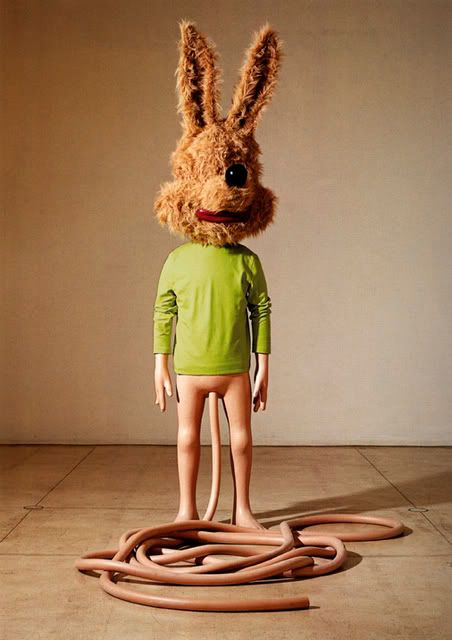
These acrylic paintings, like a lot of Watkins’ works, are drolly amusing. But sufficiently loaded so that one wonders what was going through the artist’s mind? I think he had been looking at Paul McCarthy’s Spaghetti Man sculpture. Was he really thinking about ‘speculation and rebirth’ as John Wales in the gallery hand-out suggests? I doubt it. One thing’s for sure. He wasn’t too preoccupied with botanical dehydration.

One is loathe to speculate (of course), but if compelled to (I am, I am), one might wonder if Watkins is anxious about certain bodily performance skills often linked to infestations of spam. Maybe he can’t get enough? Maybe he gets too much? Look at the Roswell work, a seated skeleton. It pretends to be about aliens but in fact is clearly about shame. The paper bag over the artist’s head confirms that. Continuous sex has made him lose a lot of weight, and the metal tub is for washing away the guilt.

Perhaps such talk is being ludicrously and pathetically sex obsessed. Let’s try another angle. Maybe the artist has a bladder problem. Perhaps he likes to pee higher on the urinal wall than other men. Hell, it is possible he can’t piddle at all, or too much, or is apprehensive of that future possibility.

Ok! Enough! The truth probably is that Watkins hates plants, doesn’t yearn to suffer from priapism and like everybody else, dreads becoming elderly. The work actually seems to refer to certain motifs in comic art (such as Mad’s Alfred E. Neuman), or key personalities in art history - like McCahon (making waterfalls with his hose) and Pollock (Jack the Dripper) dribbling paint onto a canvas laid out on the floor. These look like rebuses waiting to be decoded.

Watkins is no fool. He knows his images are loaded and that his audience loves to talk about what they might mean. Maybe with the rubber tubing entangling itself around the gardener’s body there are profoundly existential (and fetishistic) interpretations I haven’t thought of. Maybe you can? It is worth you hopping out to Parnell and checking these deliciously nutty paintings out for yourself.

Tuesday, May 6, 2008

Vibrant chroma and shape


Denys Watkins: Delhi Drawings
Gus Fisher, Auckland
11 April – 24 May 2008

When you enter the Gus Fisher Gallery, the small back room on the right, has been taken over by Denys Watkins for a striking presentation of work he made in February 2003, during a residency in Sanskriti Kendra in New Dehli. The result is a wondrous transformation. Painting the main wall green and an adjacent column blue, he has created a theatrical environment for the acrylic and oxide paintings he made on local handmade paper. This paper has a gridded, weavelike texture.

Of course saturated powdered wall colours inside buildings is a distinctive characteristic of that part of the world, and Watkins has picked images from the nearby village, such as Ganesh the elephant god, and occasionally Hanuman the monkey deity, for a rich array of images that also includes references to cricket, the national obsession. Watkin’s treatment of the images has a Matisselike emphasis on flat unmodulated colour and virtuoso nuance of contour, with hints of Motherwell or early Prieto.

It is a terrific exhibition, gorgeously sensual and easily the best I have ever seen in this room, and in fact, maybe the best in the whole gallery in recent years. It gives you a vivid sense of another culture and location, and how on a popular level the personalities and iconic presence of various deities there are so pervasive. Something completely foreign to the western mindset.

Nowadays Watkins exhibitions are rare. I’ve only seen only one other solo show of his and that was in Wellington (then again I’m a new resident in Auckland). However I vividly remember his contribution to Francis Pound and Andrew Bogle’s ‘New Image’ show at Auckland Art Gallery in 1983. His work was very graphic and linear then, but this show twenty-five years later is mainly about the pleasures of matte colour and shape. An essential exhibition to visit.

(Thank you Andrew Clifford and Jennifer French for the images)