Nau mai, haere mai, welcome to eyeCONTACT, a forum built to encourage art reviews and critical discussion about the visual culture of Aotearoa New Zealand. I'm John Hurrell its editor, a New Zealand writer, artist and curator. While Creative New Zealand and other supporters are generously paying me and other contributors to review exhibitions over the following year, all expressed opinions are entirely our own.
Showing posts with label Neil Pardington. Show all posts

Thursday, March 4, 2010

Sometimes it is good to get more than one opinion on a single show…


Unpacking My Library: Dan Arps, Xin Cheng, Bill Culbert, The Estate of L. Budd, Peter Madden, Daniel Malone, Elizabeth McAlpine, Neil Pardington and Ann Shelton.
Curated by Stephen Cleland
Te Tuhi
13 February - 11 April 2010

This show spirals around the distinction between a library and a collection, for although the two are obviously very different, in many people’s minds they often end up becoming interchangeable. Especially if you believe that objects and the sensations they provide can have their codes read as if they were newly opened books.

Is a library something like a wine cellar (the objects contained use–up-able eventually) or is it more like a wardrobe, a source of references in your conversation that you put on like wearable tactile garments? The roles of favourite sensations, reliable ideas, and certain zones in between – can all these be noted and stored to be savoured again in the future?

To introduce this theme in-house curator Stephen Cleland has had printed on a poster a beautiful passage from the well known essay that provides this show’s title. Written by Walter Benjamin, the patron saint of, indeed the founder of, art theory, and published first in 1931, it discusses the pleasure of building up a collection through pursuing individual items. Much like say, stories about the great Russian novelist Vladimir Nabokov running through country fields with his net, chasing butterflies - a lifetime obssession.

Cleland’s show though is only partially about books. Much of it is about catalogues, taxonomies, and how we classify things. That aspect pertains more to another great figure in theory, Michel Foucault than to Walter Benjamin, and Foucault’s amusement (as discussed in his preface to The Order of Things) at Jorge Luis Borges’ account of a particular Chinese Encyclopaedia where animals are classified by being: (a) property of the Emperor, (b) embalmed, (c) tame, (d) suckling pigs, (e) sirens, (f) fabulous, (g) stray dogs, (h) included in the present classification, (i) frenzied, (j) innumerable, (k) drawn with a very fine camelhair brush, (l) et cetera (m) recently the cause of a broken water pitcher, (n) similar from a long way off to a row of flies.

Of the nine artists here only two specifically use books: Ann Shelton and Xin Cheng. Room stalwart Cheng also presented a library in last year’s Article 27 show in North Shore curated by Richard Dale. Her space this time in Te Tuhi is bigger and less cell-like, with a large square plywood table and four boxlike plywood chairs. On the table are nineteen hardcover publications, many from local libraries. Most are about architecture, design, clothing and cooking.

This sort of exhibition promotes the notion of art being research, so it invites gallery visitors to dig out information and become artists themselves. For example I have personally decided to seek out certain books at various libraries after they have been returned. Four in particular are especially appealing: one, The Architect, The Cook and Good Taste connects building with cooking; another looks at chair designer Rolf Fehlbaum and how chairs are conceived; a third presents coloured photos by Albert Kahn taken around the world during the second decade of last century; and a fourth examines Scandinavian knitting patterns.

The theme of books continues in five small video screens from Ann Shelton set in a line on a long wall. They feature her continued fascination with Frederick Butler, whose archive of thousands of cards and books (many of which are old novels he used as scrapbooks for local newspaper cuttings) are kept in the New Plymouth public library. Her nine videos show the pages of volumes left out of the 'spinal' photographs but included here, turning through each volume one at a time, and revealing scribbled annotations, lists, dates, charts, cartoons, headings and more. They, especially the clippings, are very hard to read but they attempt to whet your appetite.

It is difficult to pin down the value (if any) of Butler’s unusual obsession, and if he fits as an artist (he probably doesn’t because he didn’t think of himself as such) or as a social historian (again probably not, for in this field he may have done more damage than good - for the newspapers would be more useful intact.) Shelton’s earlier well known series of life-sized photos of the spines of Butler’s archive, as seen on the library storage shelves, is amazing, but these page-turning videos ram home a connection with Borges’ Chinese encyclopaedia. The headings of four consecutive pages in one notebook on medical conditions go as: pimples; prunes; potassium broth; potatoes. There may be a coherent logic here, to do perhaps with bio-chemistry, but it is not very clear.

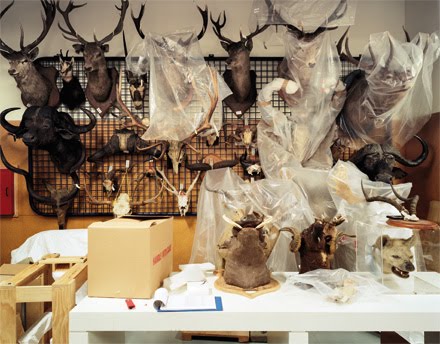
The three Neil Pardington Lambda/C-prints displayed come from the basements of Te Papa, Auckland Museum and the Hocken library. These very detailed images show items of mammal and marine life, rolled up textiles stored on steel rods, and a box of catalogue cards.

How does one 'read' these? Well the long triptych from Te Papa reveals masses of mounted deer heads that most likely will never be displayed, and what seems to be a killer whale skull that probably will. Auckland Museum’s rolled up rugs are stored slightly over on the left hand side of the racks bearing horizontal bars – perhaps a vague comment on some bias of sorts, and the Otago cupboard of filing cards with labelled catalogue drawers makes a gorgeous grid that obscures (but potentially confirms) the rationale of the enclosed register for the art collection.

The logic of organising such inventories is tested to opposite extremes by British artist Elizabeth McAlpine and The Estate of L. Budd. McAlpine continually collects postcards of Big Ben and the Houses of Parliament – of different periods and sizes. To present them on a wall she uses a huge 12 x 60 matrix of 720 plastic pockets. She has about a third of that number of cards in total.

The system she uses to position each card in the grid for display depends on the time shown on the clock dial: vertical co-ordinates equal hours; horizontal equal minutes - so you place the card where they cross. Day and night are blended, and McAlpine plays on the fact that in some images the time is indecipherable, or one hand at least is hidden by shadow. Therefore her system, which looks impressive at first glance, is not totally reliable, for she has to make arbitrary decisions sometimes. Some cards are repeated three times.

The contribution of The Estate of L. Budd to Cleland’s exhibition is to turn one of the gallery rooms into a little warehouse, bringing in for this show (but not ‘displayed’) various works made by that artist stored in different locations scattered around the country. On the temporary shelves we see bulky storage boxes daubed in characteristic grey with scribbled crayon, heaters, turntables, suit-cases, cabinets, and sound gear. And various rolled up awnings and paintings lean against an end wall.

A catalogue for The Estate’s ‘Extant Works’ hangs off one shelf, and its pages are also pinned to one wall. An ambiguous blue taped line runs between the shelving and the space where the viewers enter, half suggesting they go no further. A surveillance monitor watches from one corner.

More importantly, The Estate of L. Budd monitors itself. Problems of authenticity are adjudicated where collectors are invited to submit ‘applications of registration and authentication’ for possible Budd works not yet listed. The Estate shows caution in instigating such bureaucratic procedures, exhibiting samples of blue Approved or Denied stamps and being forever vigilant, in case dubious ‘L. Budd’ works appear in the future - possible forgeries attempted maybe by P. Mule, Arthur Craig and Sons, Blanche Readymade, et al. and others.

Daniel Malone’s work is a catalogue attempted by memory alone, listing all the personal possessions (including cardboard rubbish he refused to discard) that he left behind when he moved to Poland, where he now lives, and which made up a Gambia Castle exhibition he sold to the Chartwell Collection.

The recounted, shorter list was written on a long wall in Paintstik by an assistant using a ‘tagger’ script with upper case printing and vertical bars through S’s and O’s. It vaguely relates to Douglas Gordon’s list on a wall of everybody he has ever met since 1990 that he can remember. Malone’s attempted inventory, with its graffiti form of presentation, seems out of place within a municipal gallery where it looks compromised. It would make a far more interesting project if it were ‘defacing’ Te Tuhi’s outer walls and genuinely drawing on the urban politics of the text ‘font’.

Eight freestanding sculptures by Dan Arps fill one small gallery, and demonstrate the merits of recycling elements from disparate exhibitions, scattered in time and place, to make something new. Some aspects of this show refer to Arps’ TWNCAA entry in Hamilton for 2005 (Creation Myth), others to Telecom Prospect in Wellington a pinch later, and others still to a Gambia Castle show held last year.

Arps’ sculptures use office swivel stools, bookcases, and old clothing dressers as plinths for hybrid versions of kitsch ceramic garden ornaments, and are very entertaining. They revel in messy and dribbly sculptural processes, with say, bits of paper decals on desks alongside bits of cardboard Buckminster Fuller models or resin/ceramic goblins or toadstools.

This is a restrained show for Arps, one that is oddly elegant with its uncluttered calculated placements. It is the highlight of the nine Te Tuhi exhibitions, a sort of ‘Dan Arps’ Greatest Hits’ with a surprising accessibility.

Using a darkened annex and revolving carousel of eighty slides with a translucent wall, Peter Madden presents a set of installations and collages that are tightly connected as a sample of his practice. The shots are taken from a variety of positions and display his usual subject matter of exotic tropical wildlife, Southeast Asian Gods, hands and expressive facial portraits. Like Arps (and often Budd and Malone) there is an interest in recycling forms that can subvert standard cataloguing procedure and which perhaps drives registrars worried about provenance of ingredients frantic. With Madden, there are so many parts to each installation that one is overwhelmed by numerical plenitude, a plethora of (usually small) components to be listed and documented.

Bill Culbert’s double-row of sixteen black and white photographs butted together provides a good inventory of his visual interests and modes of thinking. In this sampler we see a number of approaches to light’s effect on surfaces – or lack of, as darkness. There is behind, on top, emitting from within, and through transparent layers. Then there is the visual punning: jokes about fake table and chair legs, or concave pot surfaces and convex bulbs. These square images are like chapter headings in a book, or subfolders of files within a larger computer folder for research – guides to thematic approaches that are part of an artist’s brand; unpacked slices of their oeuvre.

Cleland has put together here a clever and unusual show that illuminates not so much specific examples of collecting as its relationship to maintaining types of certain art practice, while commenting on collecting’s general ordering principles and common administrative procedures.

In descending order the images are of works by Xin Cheng, Ann Shelton, Neil Pardington, Elizabeth McAlpine, The Estate of L. Budd, Daniel Malone, Dan Arps, Peter Madden and Bill Culbert.

Monday, February 22, 2010

Stephen Cleland has put together a new show for Te Tuhi. Here is a review from

Kate Brettkelly-Chalmers. (I've some thoughts of my own I hope to post next week.)


Unpacking My Library: Dan Arps, Xin Cheng, Bill Culbert, The Estate of L. Budd, Peter Madden, Daniel Malone, Elizabeth McAlpine, Neil Pardington, Ann Shelton.
Curated by Stephen Cleland.
Te Tuhi Centre for the Arts
13 February – 11 April, 2010

There’s something quite amusing about staging an exhibition that looks at collecting during the height of Auckland’s humid summer. Anyone who has watched a treasured artwork or book expand and warp with moisture during these months understands the difficulties of preserving a collection here. Nevertheless, the latest group show at Te Tuhi Centre for the Arts Unpacking My Library brings together artists who contemplate the trials and pleasures of collecting; of keeping objects and ephemera that one can’t quite let go of.

The stage for this exhibition is duly set with Neil Pardington’s large-scale photographs of museum storage rooms and equipment. Much like nocturnal creatures, artworks and museum objects have another, somewhat unseen life away from exhibition spaces and studios. Pardington documents this air-conditioned world of careful packaging and specialised storage devices, looking at the storerooms of collections held by New Zealand institutions including Te Papa Tongarewa and the Hocken Library. A ‘behind the scenes’ look is always fascinating, especially when the means of collecting become just as curios as the collection itself, but the themes of this exhibition gain greater traction in other artist’s work.

The entire Estate of L. Budd, deceased member of the et al. collective, is stored in one gallery and reminds us that the packaged life of an artwork often outlasts that of the artist who created it. The coils of bureaucracy are relished in this gallery-turned-storage-room where viewers might peer through tediously detailed (and probably meticulous) catalogue records and carefully crated artworks. The white paint of several of the Estate’s ‘blonded’ objects, presumably dating from the 1990s when L. Budd was said to be active, can be seen through their bubble-wrap enclosures.

Not surprisingly, the relationship between the et al. collective and the Estate of L. Budd is not articulated. Rather than aiding clarity, the Estate’s bureaucratic mechanisms — its intimidating sheafs of records and methods of categorisation — seem to perpetuate an ongoing ambiguity. It is the very promise of perpetuity that is at stake here. Not only does an art practice gain an ongoing presence in a carefully preserved collection, so does its means of organisation. The prescient and troubling character of L. Budd’s Estate lies where its systems step away from their formative functions and start to take on lives of their own.

These concerns are nicely echoed in Daniel Malone’s wall work in Te Tuhi’s largest gallery, Black Market Next to My Name: From Warsaw, From Memory. It acts as a postscript listing all the items the artist can remember including in his fantastic show at Gambia Castle in 2007. This pseudo-catalogue, a graffiti scripted list covering the breadth of one wall, is pretty tame compared to the chaotic undertaking of Malone’s 2007 work which saw him install a massive collection of possessions in Gambia Castle’s five rooms. Individual objects on the list seem banal, but in their collected grouping cigarette packets, plastic bags, records or knitted jumpers became fascinating; a documentation of a life of unfettered accumulation.

Rumour has it that some of the objects appearing in Malone’s 2007 show didn’t even belong to the artist (it’s understandable: who doesn’t have a book or beach towel belonging to someone else at their house?). It does, however, provide problems for institutional cataloguers who need to record and account for every part of an artwork. The acquisition of Black Market Next to My Name in its entirety by the Chartwell Trust/Auckland Art Gallery adds another intriguing layer to this work; an amplification of its absurd qualities.

Unpacking My Library is a show that allows these and many other perceptive connections to be made between artists’ work. Nevertheless, within the terms of the curatorial theme, the most interesting work for me was Dan Arps’ installation of found and remodelled objects. Arps showed a collection of small sculptures carefully presented on and around defunct pieces of furniture. Originating somewhere between an office and a bedroom this collection of shelves, chairs and other fixtures retain layers of dust and other signs of disuse.

Arps’ precise placement of individual pieces gives a prop-like appearance to this installation: a stagey minimalism of found objects. But props for what? These sculptures, both forlorn and comical, imply a personal narrative but evade a clear-cut story. I immediately recognised a set of drawers from my childhood covered in scuffed and torn Garbage Pail Kids stickers from the 1980s (they were a bad-taste parody of the saccharine Cabbage Patch Kids dolls). Arps’ work invokes a kind of nostalgia that is heavily laced with abjection—a grimy element that undermines any sense of sentimentality.

Unpacking My Library operates at a similarly nostalgic distance. Aside from the marvel of Ann Shelton’s digital documentation of the Fredrick Butler Archive, most of the works in this show have a distinctly analogue character. It feels all the more distant given the presence of digitised archives and collections in our daily lives. Years worth of email correspondence, blogs publically cataloguing their subjects’ daily movements and masses of snapshot photos available through social networking sites like Facebook offer an instantaneous form of collection and archival preservation. Instead of this continual murmur of information and images, curator Stephen Cleland creates a highly considered, quiet and controlled environment. The usually bustling gallery has windows shaded, doors closed and the sticky Pacific air brought to a temperate level. It is as though Te Tuhi, a non-collecting gallery, has temporarily tried on the shoes of a stately institution offering viewers a dry and studious relief from the humidity outside.

The images, in descending order, show works by Pardington (2), The Estate of L. Budd, Malone, Arps, Shelton, Culbert, and McAlpine (on the lefthand wall).

Sunday, November 22, 2009

Neil Pardington in Christchurch: some observations by Andrew Paul Wood


The Vault: Photographs by Neil Pardington
Christchurch Art Gallery
until March 14

Newly arrived and totally ignorant of the Levantine languages, Marco Polo could express himself ... with objects he took from his knapsack – ostrich plumes, pea-shooters, quartzes – which he arranged in front of him like chessmen. ...one city was depicted by the leap of a fish escaping the cormorant’s beak to fall into a net; another city by a naked man running through fire unscorched; a third by a skull, its teeth green with mould, clenching a round, white pearl. The Great Khan deciphered the signs, but the connection between them and the places visited remained uncertain; he never knew whether Marco wished to enact an adventure that had befallen him on his journey, an exploit of the city’s founder, the prophecy of an astrologer, a rebus or a charade to indicate a name. But, obscure or obvious as it might be, everything Marco displayed had the power of emblems, which, once seen, cannot be forgotten or confused. In the Khan’s mind the empire was reflected in a desert of labile and interchangeable data, like grains of sand, from which there appeared, for each city and province, the figures evoked by the Venetian’s logogriphs. ... Perhaps, Kublai thought, the empire is nothing but a zodiac of the mind’s phantasms.
“On the day when I know all the emblems,” he asked Marco, “shall I be able to possess my empire, at last?”
And the Venetian answered: “Sire, do not believe it. On that day you will be an emblem among emblems.” - Italo Calvino, Invisible Cities (1983)


In 2008, as I was wandering the hinterlands of Lower Saxony in the northernmost part of Germany, in the chocolate-box exquisite town of Oldenburg I happened to visit the local museum of natural history. I wanted to gape at preserved bog men and touch base with the bronze age roots of my Pakeha-ness. One room was done out to represent a nineteenth century zoological display, and quite unexpectedly I came eye to eye with three rather forlorn looking stuffed kiwi. I had a sudden pang of home-sickness and identification – I felt very far from home, exotic and somewhat on display. Suddenly being a New Zealander felt concrete for me. The museum’s records revealed nothing of how they came to be there, just the ornithologist’s names, the Linnean Latin and that they came from “Neu-Seeland” in the nineteenth century, but I bring up the story because I get the exact same sensation when looking at Neil Pardington’s exhibition The Vault at Christchurch Art Gallery.

Pardington and his sister Fiona are easily among the most important photographers working in New Zealand today. The images in The Vault are documentary in that they record museum storage areas around the country, much as an earlier series surveyed hospital surgeries. The repetition and archiving are an important artistic strategy – one thinks of the Bechers’ water tower photographs and Warhol’s endless Maos and Marilyns – but beyond that Pardington’s images are rich with mystery and even melancholy. The richness and diversity of colours and textures, and the neat ranked order of things carefully placed seduce the eye. We wonder about the stories behind these boxed and tagged objects (which quite likely have never been on public display).

Museum stores are liminal spaces; unfettered of the need to educate or appeal to an audience, they are beholden only to the economy of space, conservation and efficient retrieval. In essence, we might even describe Pardington’s large, beautiful images are meta-diagrams of Aristotle’s cataloguing and ordering philosophy stripped of the trappings of display. And yet, they are on display in the form of the photographs – the line between display space and back of house is irrevocably blurred, even inverted. The photographs make the racks and boxes exclusively aesthetic – we don’t have to know anything about the habitat of the dead seagulls (forming the sort of “symphony in grey” that would have appealed to Whistler) or the precise ethnographical meaning of the Samoan clubs (perhaps with the faintest suggestion of his sister Fiona’s evocative photographs of Maori taonga), we’re just here for the colours and forms (all masterfully handled). A set of specimen draws is transformed into a cross between Mary Kelly’s Post-Partum Document and a minimalist grid by Donald Judd.

Storage, is by its very nature, a minimalist grid, but the artifacts and fauna stored therein are baroque and luscious and this paradoxical juxtaposition lends an aesthetic frisson to the whole endeavor that was perhaps lacking in the starker images of hospital operating theatres of a few years ago.

More often than not the photographs are testament to the Victorian obsession for collecting and imperial acquisition (the sort of thing that makes modern collections managers twitch for a good de-accessioning). Each image is fundamentally a Wunderkammer (cabinet of curiosities) by proxy, and en masse make me slightly giddy. The vast gallery space becomes a cathedral of curiosities. At the same time there is this delicious frisson of something usually private and unseen made public in a very visual way. Any of these could prove a Proustian Madeleine to trigger a cascade of tiered reverie and semiotic free association of the sort we pointy-headed types are fond of. Indeed, I am reminded of something Proust on the painter Chardin: “Until I saw Chardin’s paintings I never realised how much beauty lay around me in my parents’ house, in the half-cleared table, in the corner of a table-cloth left awry, in the knife beside the empty oyster-shell”. The photographs are the still life equivalent of a found poem or an objet trouvé.

We feel that we are being let in on a secret, a sort of Eleusinian mystery. The act of viewing takes on a slightly sacramental quality and the gallery space does indeed become cathedral like, full of reliquaries; or even slightly tomb-like with the viewer in the position of the archaeologist seeing what has been hidden from public view for centuries.

I have to say I am very much a fan.

(The images above have been sampled from Neil Pardington's The Vault page on his website. They are not necessarily included amongst his 35 images selected for Christchurch.)