


To Say The Least: Ruth Buchanan, Ash Kilmartin, Sarah Rose, D. M. Satele, Holly Willson
Newcall
15 October - 31 October 2009
This five artist show at Newcall has austere tendencies towards not so much minimalism, but rather, dematerialisation. Often this consists of traces that allude to earlier states that are fuller and denser with information, fields from which a selection has been made. Prying elements free of their original context.
Sarah Rose has two works that draw this out. One is a series of thirty A4 sheets with typed nouns pinned to the main wall. The words descend from left to right in the formation they would be positioned in within their original context: various Emily Dickinson poems.
Oddly Dickinson (1830 -1886) is a poet where there has always been a lot of conjecture about her original drafts - because of the many versions she left with variant wording, spelling, line length, punctuation and of course ultimately, meaning. The fact that Rose has worked with Dickinson’s ‘final’ texts is amusing because of their slippery nature - and variable interpretations that seem to change with each new anthology editor.
Brevity of fame is the content of Rose’s other work. On an outside window is a page with ‘as long as a rainbow lasts’ typed on it. Inside, on a timer so it plays only intermittently, is a nearby video clip of Nadia Comenici, fourteen year old Romanian gymnastic star of the 1976 Olympics, performing some of her perfect scores – memory flashes (for some) of thirty-three years ago.
Holly Willson’s two aural works are related to Rose’s visual contributions. One is a crashing piano chord that comes through the office door, and the other a selection of four fast snippets taken from a vinyl record. (Though it is highly unlikely, to me the samples sound like bits of Dylan’s ‘Blonde On Blonde’.)
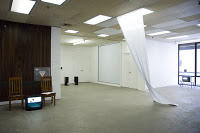
Willson has a third work of a wide strip of muslin extending down from the ceiling, but twisted (flipped over) halfway down, and neatly folded on the floor. The stretched material seems to be a metaphor for time, and perhaps spatial context.
Related to both Willson and Rose’s projects is the display of residue from D. M. Satele’s opening night performance: two chairs; a video of some guy sitting on a bed in his underwear yakking on the phone; and two bound transcripts of six jokes from comedienne Wanda Syke’s ‘Tongued Untied’ TV series. More than props that remain from a past event, the joke transcripts seem a poignant trace of the television comedy - its shadow.
The works of Ruth Buchanan and Ash Kilmartin seem to have quite different sensibilities. Kilmartin has a small pile of paper pages on which he has written in pencil a text that diminishes in size as the pages get closer to the floor. It declares the work to be ‘self sustaining sheets’ and its logic seems to be that as the paper pile gets lower, the text is supported less by the paper and more by the floor. The accuracy of the text alters according to the position of each page in the pile.
Buchanan’s project is a fake lecture about problems of architectural relevance to local needs, that you listen to through headphones resting on a mirrored shelf. On part of it the speaker refers to buildings on the Chatham Islands that have specially designed flexible joinery. This lets them sway under pressure from the ferocious winds, thus providing a source of relaxation for the inhabitants.
Like Kilmartin’s sculpture where you have to look at several sheets to get its point, with Buchanan you need to listen to most of the recording to get its humorous drift. Looking at too few components won’t help you much.
This is a finely nuanced exhibition, probably Newcall’s best ever group show. The five contributors work beautifully together. Well worth a visit.


