Showing posts with label 4th Auckland Triennial. Show all posts
Monday, April 19, 2010
Last Ride in a Hot Air Balloon: Part Four - The Economy
The 4th Auckland Triennial: The themes
Learning Site, Michael Stevenson, Olivia Plender, Garrett Phelan, Jorge Macchi
Various Auckland venues
12 March - 20 June 2010
Of the five themes I have selected, the one of global economy is the aspect I think Natasha Conland handles more adroitly than any other. The above set of five artists makes a nice bundle that explores the nuances of this subject, with lots of interconnections. And even though I personally am not particularly interested in this topic, the work drew me in and to some extent, changed that. I got hooked.
Take a group like Learning Site for example – from Denmark and Sweden. I tend to dislike ‘school teacher art’, work which goes all out to educate and which openly presents information – usually historical – in the form of an installation or performed lecture, with the expectation that the audience will absorb it. Good education (most of us know) is far sneakier than that. It entertains so that the ‘student’ is unaware that they are learning. They become interested and take stuff in by virtue of having fun.
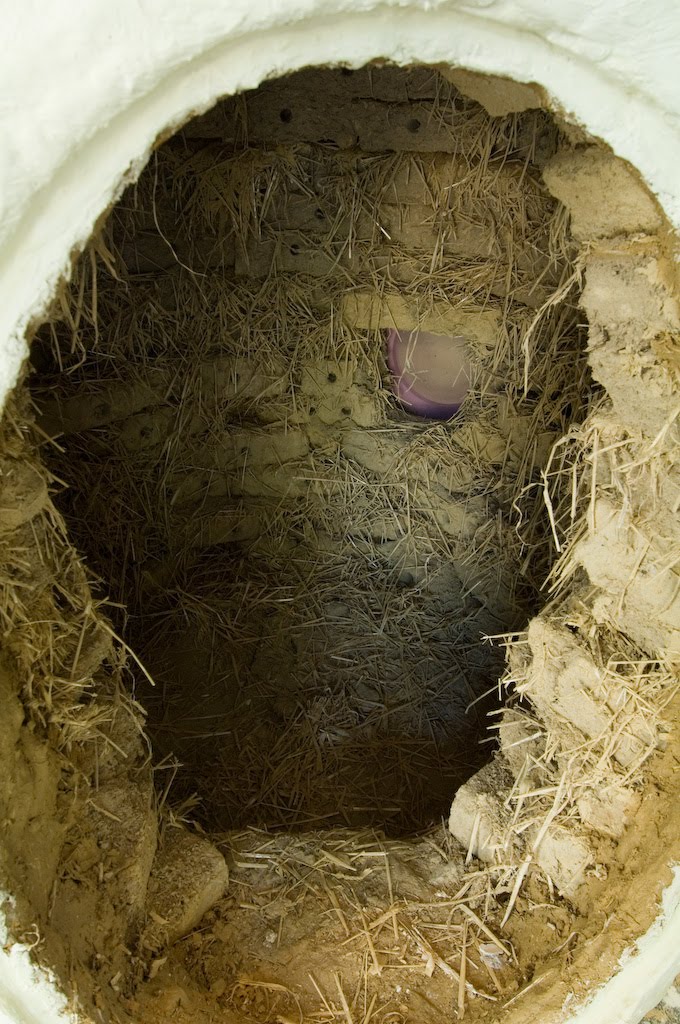
With Learning Site it wasn’t so much the disintegrating, mushroom seeded, ‘termite mound’, clay sculpture (House of Economy) at the base of the two gallery escalators that appealed to me - though it did - as the elegant little pamphlet made available with it. Anthony Iles’ text Crises, Ruin, Allegory is very informative and the illustrations helpful. The content, especially the discussion of economics as ‘the dismal science’, and his examination of the 1720 South Sea Bubble phenomenon, locks in tightly with the wonderfully poetic and visually nuanced Michael Stevenson video and the satirical posters and board game of Olivia Plender.
Stevenson’s On How Things Behave highlights global economics as ‘things’ and has an appropriately lugubrious mood set by the voice over, provided by Suzanne Mārtens. Her fourteen minute long, monotonously gloomy reading is offset by the skilful and witty linking by Stevenson of a wide range of texts. These range from philosophical treatises by David Hume and Nelson Goodman (on grounds for prediction and categorisation of qualities) to accounts of Issac Newton’s investment losses in 1720. They also include visual allusions to the economic-sunspot theories of W.S. Jevons. Stevenson’s imagery is meticulously thought out, with tracking shots of a long wall featuring a mural by Manfred Gnādinger, a hermit who died after his home was wrecked by the Prestige oil spill, and various incorporated circular (solar) symbols, such as hollow Russian, spherical, wooden dolls.
Plender’s set of snappily designed, parodic ‘Victorian’ posters is particularly amusing. One features a 2006 whale sighting in the Thames Estuary as an ominous economic omen, another references the suffragette Mary Richardson’s attack on Velázquez’s Rokeby Venus in 1914 in the National Gallery, a third posits an imperialist British seizing of Iceland’s bank assets, and one more warns of the availability of carved wooden nutmegs and other fraudulent comestibles on the market.
Her board game Set Sail For the Levant grimly sets out crime as the only viable alternative for the poor tenant farmer enduring increasing rents at the time of the Industrial Revolution. Faced with increasing debt, he steals the landlord’s gold and attempts to get to the Eastern Mediterranean where the law can’t touch him, and letting others pay the cost. Plender’s game is based on the sixteenth century Royal Game of the Goose, a early precursor of Snakes and Ladders or Ludo.
Garrett Phelan’s installation is much rawer visually and more openly abrasive in mood. It features a looped animated DVD, framed drawings, a separate but simultaneous crackling audio component picked up by a radio from a nearby broadcasting transmitter, and a purchasable comic (Selflessness in the Face of Adversity) in which Phelan’s wild ink drawings are positioned alongside Free Trade and Human Rights in a Sustainable Environment, an essay (handwritten by Phelan) by the curator and collector Jobst Graeve.
‘Free’ trade of course means not the liberty of people but the unimpaired flow of goods and services within a relationship of exchange that is often not balanced or equal. As a means of bypassing the self-interest of banks and corporates, Graeve has devised a formula for calculating a fair pricing system for all goods and services, taking into account the energy necessary for the production and fabrication of raw materials, the effect on workers’ health, the recycling potential and time taken, along with the effects on energy, wealth, and the environment for both production and consumption.
The last artist in this group has a contradictory lightness of touch and far less intense ambience. Jorge Macchi’s videos of manually wound music boxes playing cardboard strips of punched holes stating sentences of economic catastrophe from newspaper headlines, are surprisingly pretty and buoyant. They don’t sound random or grimly chaotic as you might expect, but are perversely melodic – as if these events’ calamitous significance has been exaggerated. They seem oddly celebratory and uplifting, even optimistic, thumbing their noses at fiscal preoccupations and any search for prosperity.
The fifth and last Triennial theme coming up: Generating Dialogue.
Learning Site, Michael Stevenson, Olivia Plender, Garrett Phelan, Jorge Macchi
Various Auckland venues
12 March - 20 June 2010
Of the five themes I have selected, the one of global economy is the aspect I think Natasha Conland handles more adroitly than any other. The above set of five artists makes a nice bundle that explores the nuances of this subject, with lots of interconnections. And even though I personally am not particularly interested in this topic, the work drew me in and to some extent, changed that. I got hooked.
Take a group like Learning Site for example – from Denmark and Sweden. I tend to dislike ‘school teacher art’, work which goes all out to educate and which openly presents information – usually historical – in the form of an installation or performed lecture, with the expectation that the audience will absorb it. Good education (most of us know) is far sneakier than that. It entertains so that the ‘student’ is unaware that they are learning. They become interested and take stuff in by virtue of having fun.
With Learning Site it wasn’t so much the disintegrating, mushroom seeded, ‘termite mound’, clay sculpture (House of Economy) at the base of the two gallery escalators that appealed to me - though it did - as the elegant little pamphlet made available with it. Anthony Iles’ text Crises, Ruin, Allegory is very informative and the illustrations helpful. The content, especially the discussion of economics as ‘the dismal science’, and his examination of the 1720 South Sea Bubble phenomenon, locks in tightly with the wonderfully poetic and visually nuanced Michael Stevenson video and the satirical posters and board game of Olivia Plender.
Stevenson’s On How Things Behave highlights global economics as ‘things’ and has an appropriately lugubrious mood set by the voice over, provided by Suzanne Mārtens. Her fourteen minute long, monotonously gloomy reading is offset by the skilful and witty linking by Stevenson of a wide range of texts. These range from philosophical treatises by David Hume and Nelson Goodman (on grounds for prediction and categorisation of qualities) to accounts of Issac Newton’s investment losses in 1720. They also include visual allusions to the economic-sunspot theories of W.S. Jevons. Stevenson’s imagery is meticulously thought out, with tracking shots of a long wall featuring a mural by Manfred Gnādinger, a hermit who died after his home was wrecked by the Prestige oil spill, and various incorporated circular (solar) symbols, such as hollow Russian, spherical, wooden dolls.
Plender’s set of snappily designed, parodic ‘Victorian’ posters is particularly amusing. One features a 2006 whale sighting in the Thames Estuary as an ominous economic omen, another references the suffragette Mary Richardson’s attack on Velázquez’s Rokeby Venus in 1914 in the National Gallery, a third posits an imperialist British seizing of Iceland’s bank assets, and one more warns of the availability of carved wooden nutmegs and other fraudulent comestibles on the market.
Her board game Set Sail For the Levant grimly sets out crime as the only viable alternative for the poor tenant farmer enduring increasing rents at the time of the Industrial Revolution. Faced with increasing debt, he steals the landlord’s gold and attempts to get to the Eastern Mediterranean where the law can’t touch him, and letting others pay the cost. Plender’s game is based on the sixteenth century Royal Game of the Goose, a early precursor of Snakes and Ladders or Ludo.
Garrett Phelan’s installation is much rawer visually and more openly abrasive in mood. It features a looped animated DVD, framed drawings, a separate but simultaneous crackling audio component picked up by a radio from a nearby broadcasting transmitter, and a purchasable comic (Selflessness in the Face of Adversity) in which Phelan’s wild ink drawings are positioned alongside Free Trade and Human Rights in a Sustainable Environment, an essay (handwritten by Phelan) by the curator and collector Jobst Graeve.
‘Free’ trade of course means not the liberty of people but the unimpaired flow of goods and services within a relationship of exchange that is often not balanced or equal. As a means of bypassing the self-interest of banks and corporates, Graeve has devised a formula for calculating a fair pricing system for all goods and services, taking into account the energy necessary for the production and fabrication of raw materials, the effect on workers’ health, the recycling potential and time taken, along with the effects on energy, wealth, and the environment for both production and consumption.
The last artist in this group has a contradictory lightness of touch and far less intense ambience. Jorge Macchi’s videos of manually wound music boxes playing cardboard strips of punched holes stating sentences of economic catastrophe from newspaper headlines, are surprisingly pretty and buoyant. They don’t sound random or grimly chaotic as you might expect, but are perversely melodic – as if these events’ calamitous significance has been exaggerated. They seem oddly celebratory and uplifting, even optimistic, thumbing their noses at fiscal preoccupations and any search for prosperity.
The fifth and last Triennial theme coming up: Generating Dialogue.
Friday, April 2, 2010
Kate Brettkelly-Chalmers adds to the continuing discussion of the Triennial


The 4th Auckland Triennial: Last Ride in a Hot Air Balloon
Various Auckland venues
12 March - 20 June 2010
The 4th Auckland Triennial: Last Ride in a Hot Air Balloon was launched a few weeks ago with a suite of gallery openings, artists’ talks and panel discussions. Curator Natasha Conland’s umbrella theme of risk and adventure engages with a diversity of current art practices. As other Eyecontact reviews already give summary impressions of the whole Triennial, this piece focuses on a group of artists and the talks they gave during the opening weekend.
What characterizes Last Ride in a Hot Air Balloon is the multiplicity of interpretations that can be made of its themes of risk and adventure. Where other triennial or biennial events might develop a rigid curatorial concept, Conland offers a more porous conceptual framework. The twenty-eight artists selected investigate various dynamics of risk-taking, from explicitly looking at our current financial recession to examining the physicality of risky activity or simply exploring various material conditions.
The multifarious nature this Triennial might exasperate those who would like an explicit pairing of artist and curatorial concept. In some instances, such as Martin Boyce’s fantastic sculptural pieces at St Paul St, ideas of risk taking and adventure do not seem appropriate or useful as a means of engaging with the artworks on show. I found that the curatorial premise was most effective where it articulated relationships between different art practices.
During the opening weekend I was particularly fascinated by the relationship between Alicia Frankovich’s sculptures and the films of Mike Parr. Frankovich’s series of sculptural pieces at the New Gallery investigates the form of the human body in relation to everyday materials. In the centre of her space hang two Martini bottles attached to a pump circulating a red coloured liquid. Clearly a reference to body fluid, this booze-bottle water feature humorously hints at the presence of alcohol in our systems. Like her memorable performances at ARTSPACE last year, Frankovich creates potentially risky bodily engagements and reveals that they are not without ethical implications.
At her artist’s talk I was intrigued to hear Frankovich speak of her sculptures as performances. Works such as Lover, a human form vaguely traced in neon tubing hanging from a coat hanger, or Piston, a round ball suspended precariously from the ceiling, do not immediately speak of performative concerns. But the lightness of their construction does suggest an agile physical quality. At her talk we were also reminded that Frankovich was once a competitive gymnast. Indeed, her engagement with the effects of gravity has an athletic flair—these works could topple over at anytime.
Where Frankovich’s ARTSPACE performances were powerfully simple and coherent, these Triennial pieces function more like a series of drawings, experiments that explore the space between sculpture and performance.
Performative parameters were also discussed at Mike Parr’s artist talk. Parr spoke about his significant career as an Australian conceptual and performance artist as he discussed his early works on show at the George Fraser Gallery. This talk even tended toward performance in itself. At one point the artist read out a list of actions for possible works that he’d written in the 1970s. Directives such as ‘Hold your breath under water for as long as possible,’ or ‘Drip blood from your finger onto the lens of a camera...until the lens is filled with blood’ varied from the torturous to the mundane. As Parr finished reading each page of directives he let these papers drop one by one on the ground. Whether this was intentional or not I couldn’t help but associate these discarded pages with the artist’s video One Hundred Breaths being projected in the next room. In this video Parr sucks pieces of paper onto his face until he runs out of air and needs to take a breath. What gives this slightly ferocious work its poignant overtones is that each piece of paper bears a self-portrait of the artist. Parr is elevating his own image with all the air in his body, creating a tangible link between self-image and physical reality.
Alongside Parr and Frankovich, the body’s movements are also explored in Tino Sehgal’s work Instead of allowing something to rise up to your face dancing bruce and dan and other things. Known for his ‘constructed situations’ — choreographed movements or exchanges involving one or many people — Sehgal does not allow any documentation to be made of his work, nor does he use the term ‘performance’ to describe it. At St Paul St a man dressed in casual jeans and a jacket made a very purposeful wriggling movement along the concrete floor of the gallery. His unusual sliding actions had the precision and attentiveness of a professional dancer — someone who is acutely aware of their body.
Derived from Bruce Nauman and Dan Graham videos, Sehgal’s piece has been reenacted in galleries across the globe. Anna Macrae is the New Zealand dancer who facilitated Sehgal’s piece. At a panel discussion on the opening weekend she spoke about the process of developing this work in New Zealand. Macrae, who is currently living in Berlin, happened to be coming back home during the period of the Triennial. Seeking to avoid any unnecessary travel, Sehgal and Conland arranged for her to ‘learn’ the choreography in Berlin and teach it to six professional dancers based in New Zealand, who would in turn reenact it at St Paul St.
Macrae’s remarks at the panel discussion revealed that the scope of Sehgal’s work goes beyond what occurs in the gallery, beyond a single person moving across a concrete floor. It is a constructed situation comprised of a series of incidental actions and connections—small movements across space and time.
Although this Triennial’s themes of risk and adventure may seem tenuously linked to the artworks on show, Last Ride in a Hot Air Balloon does offer a myriad of smaller, intriguing relationships between different art practices. It presents constellations of artists whose share subjects and modes of investigation across gallery spaces. It is a show that requires an attentive approach to viewing—something that is well worth the time.
The images above ascend from Mike Parr's video One Hundred Breaths, shown at his artist's talk at the George Fraser opening.
Then there is Parr's Facts About The Room (1970), and three details from Alicia Frankovich's presentation in The New Gallery.
Subscribe to:
Posts (Atom)


