Nau mai, haere mai, welcome to eyeCONTACT, a forum built to encourage art reviews and critical discussion about the visual culture of Aotearoa New Zealand. I'm John Hurrell its editor, a New Zealand writer, artist and curator. While Creative New Zealand and other supporters are generously paying me and other contributors to review exhibitions over the following year, all expressed opinions are entirely our own.
Showing posts with label Michael Stevenson. Show all posts

Monday, April 19, 2010

Last Ride in a Hot Air Balloon: Part Four - The Economy


The 4th Auckland Triennial: The themes
Learning Site, Michael Stevenson, Olivia Plender, Garrett Phelan, Jorge Macchi
Various Auckland venues
12 March - 20 June 2010

Of the five themes I have selected, the one of global economy is the aspect I think Natasha Conland handles more adroitly than any other. The above set of five artists makes a nice bundle that explores the nuances of this subject, with lots of interconnections. And even though I personally am not particularly interested in this topic, the work drew me in and to some extent, changed that. I got hooked.

Take a group like Learning Site for example – from Denmark and Sweden. I tend to dislike ‘school teacher art’, work which goes all out to educate and which openly presents information – usually historical – in the form of an installation or performed lecture, with the expectation that the audience will absorb it. Good education (most of us know) is far sneakier than that. It entertains so that the ‘student’ is unaware that they are learning. They become interested and take stuff in by virtue of having fun.

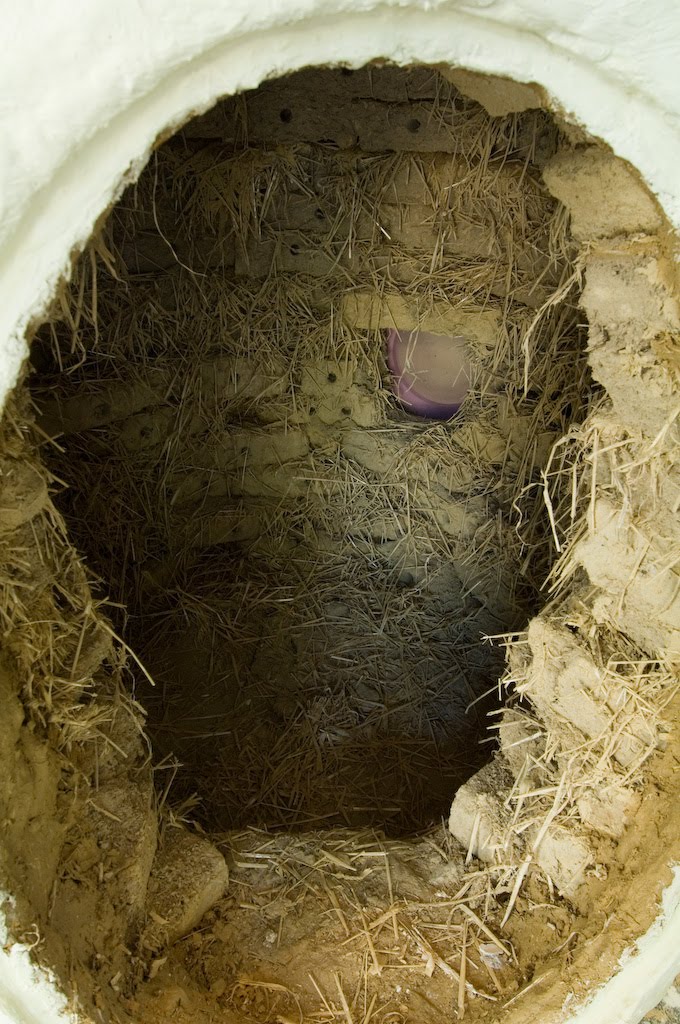
With Learning Site it wasn’t so much the disintegrating, mushroom seeded, ‘termite mound’, clay sculpture (House of Economy) at the base of the two gallery escalators that appealed to me - though it did - as the elegant little pamphlet made available with it. Anthony Iles’ text Crises, Ruin, Allegory is very informative and the illustrations helpful. The content, especially the discussion of economics as ‘the dismal science’, and his examination of the 1720 South Sea Bubble phenomenon, locks in tightly with the wonderfully poetic and visually nuanced Michael Stevenson video and the satirical posters and board game of Olivia Plender.

Stevenson’s On How Things Behave highlights global economics as ‘things’ and has an appropriately lugubrious mood set by the voice over, provided by Suzanne Mārtens. Her fourteen minute long, monotonously gloomy reading is offset by the skilful and witty linking by Stevenson of a wide range of texts. These range from philosophical treatises by David Hume and Nelson Goodman (on grounds for prediction and categorisation of qualities) to accounts of Issac Newton’s investment losses in 1720. They also include visual allusions to the economic-sunspot theories of W.S. Jevons. Stevenson’s imagery is meticulously thought out, with tracking shots of a long wall featuring a mural by Manfred Gnādinger, a hermit who died after his home was wrecked by the Prestige oil spill, and various incorporated circular (solar) symbols, such as hollow Russian, spherical, wooden dolls.

Plender’s set of snappily designed, parodic ‘Victorian’ posters is particularly amusing. One features a 2006 whale sighting in the Thames Estuary as an ominous economic omen, another references the suffragette Mary Richardson’s attack on Velázquez’s Rokeby Venus in 1914 in the National Gallery, a third posits an imperialist British seizing of Iceland’s bank assets, and one more warns of the availability of carved wooden nutmegs and other fraudulent comestibles on the market.

Her board game Set Sail For the Levant grimly sets out crime as the only viable alternative for the poor tenant farmer enduring increasing rents at the time of the Industrial Revolution. Faced with increasing debt, he steals the landlord’s gold and attempts to get to the Eastern Mediterranean where the law can’t touch him, and letting others pay the cost. Plender’s game is based on the sixteenth century Royal Game of the Goose, a early precursor of Snakes and Ladders or Ludo.

Garrett Phelan’s installation is much rawer visually and more openly abrasive in mood. It features a looped animated DVD, framed drawings, a separate but simultaneous crackling audio component picked up by a radio from a nearby broadcasting transmitter, and a purchasable comic (Selflessness in the Face of Adversity) in which Phelan’s wild ink drawings are positioned alongside Free Trade and Human Rights in a Sustainable Environment, an essay (handwritten by Phelan) by the curator and collector Jobst Graeve.

‘Free’ trade of course means not the liberty of people but the unimpaired flow of goods and services within a relationship of exchange that is often not balanced or equal. As a means of bypassing the self-interest of banks and corporates, Graeve has devised a formula for calculating a fair pricing system for all goods and services, taking into account the energy necessary for the production and fabrication of raw materials, the effect on workers’ health, the recycling potential and time taken, along with the effects on energy, wealth, and the environment for both production and consumption.

The last artist in this group has a contradictory lightness of touch and far less intense ambience. Jorge Macchi’s videos of manually wound music boxes playing cardboard strips of punched holes stating sentences of economic catastrophe from newspaper headlines, are surprisingly pretty and buoyant. They don’t sound random or grimly chaotic as you might expect, but are perversely melodic – as if these events’ calamitous significance has been exaggerated. They seem oddly celebratory and uplifting, even optimistic, thumbing their noses at fiscal preoccupations and any search for prosperity.

The fifth and last Triennial theme coming up: Generating Dialogue.

Monday, March 15, 2010

David Cross has some comments on the recently opened Auckland Triennial. eyeCONTACT will be posting several articles looking at it.


The 4th Auckland Triennial: Last Ride in a Hot Air Balloon
Curated by Natasha Conland
New Gallery, ARTSPACE, St. Paul St.Gallery, and Shed 6
12 march - 20 June 2010

It’s a very brave venture to examine risk as a trope of contemporary art. We immediately expect to be challenged, to see the status quo punctured or picked apart and to at least interrogate the possibility of new modes of social/cultural transformation. Of course risk is an elusive concept and one that does not neatly align with the rhetoric of avant garde transgression. There is a profound elasticity to the term that extends well beyond being shot in the arm for art or masturbating under the gallery floor. Such 1970s ideas about risk still resonate in the popular consciousness when risk is aligned with contemporary art even if the modes seem fundamentally old school and historically specific. While the mechanisms have shifted with our more complex globalised world, risk is still a staple component of art practice both as a subject matter to be dissected and as a critical mode of operation. Natasha Conland has decided to put a ruler under this terrain with her chapter of the Triennial choosing a targeted suite of artists for whom risk and adventure are fundamental concerns.

Trying to get a handle on how Conland locates risk is not however a straightforward enterprise. She is careful to articulate a number of registers by which artists rub against the grain and these straddle the overtly political through to the barely visible. Conscious of not privileging but at the same time not excluding an activist mode, Conland lays out a breadth of practice to suggest the multifarious nature of risk in recent art. At one axis we get the grating in your face posturing of Australian artist Richard Bell tearing at the flimsy veneer of multiculturalism. His hilarious gangsta/gonzo/psychiatrist persona performed in Scratch an Aussie and Broken English is a razor sharp dissector of aboriginal stereotypes and white ignorance. The didactic message of black resistance is couched in Bell’s work through an accessible, if incendiary, satire that takes aim at the breathtaking indifference of white Australia to black identity and history.

This overtly polemical strategy sits in a different space to the practice of a number of Middle Eastern artists who couch risk in far more delicate ways. The work of Iranian artist Mahmoud Bakhshi for instance, is potentially riskier, if superficially appearing to be more politically inert in its content. His sculptural installation Sunsets consists of a series of cigarette shaped cylinders each of which emits a recitation of a different chapter of the Koran. The audience are able to move the cylinders to create different sonic arrangements. While the work initially feels benign in its critical aspirations, the powderkeg politics of contemporary Iran and the fact the artist is based in Tehran provides a crucial context to the work. The idea of individual agency and decision making is clearly subversive in the context of the crackdown against the so-called Green revolution upping the stakes of the work considerably.

A similar though ultimately more successful edge pervades the work of fellow countryman, Shahab Fotouhi. The artist restages a number of the components of the famous helicopter ride of Ayatollah Khomeini on his triumphant return to Tehran in 1979. Employing scaffold-mounted floodlights together with neon tubing that physically plots out the route, the artist also displays documentary footage of the messianic event on a small monitor, using a mixture of found and crafted objects to investigate the staged spectacle of Khomeini’s return in a highly understated way. His comparative lack of partisan editorialising - the deadpan matter-of-factness of the installation - is ultimately a nuanced device to shut down one-dimensional interpretations of political subversion. By allowing us plenty of space to join the dots, the work suggests a whole lot while making it difficult to pin a fixed meaning down.

The attempt to establish a balanced tone between big picture politics and the poetics of objects and sound permeated a number of the works in the Triennial including Shilpa Gupta’s microphone cloud, airport display board, Sharon Hayes’ Everything Else Has Failed Don’t You Think It Is Time For Love, and Tom Nicholson’s beautifully layered deconstruction of the Burke and Wills story Monument for the Flooding of Royal Park. Yet positioned in relation to these works were a number of pieces that seemed to stretch the curatorial parameter too far. Michael Stevenson is certainly an artist known for skewering an extraordinary array of cargo cults but his video work On How Things Behave seemed to be more about the vagaries of artistic philosophical meditations with a poke at Daniel von Sturmer than about adventure or risk. Likewise the very chic relational aesthetics poster boy Philipe Parreno seemed out of place with his Marquee which in no way destabilises the conventional art viewing experience as claimed in the exhibition brochure but functions as a kind of low-fi, low-impact, largely lame entranceway.

One of the things the triennial highlights is that risk and adventure are not the same thing. Mostly the works embody one but not both of these traits. Marine Hugonnier’s evocative videos of markedly different locales are a rare example of the curatorial synthesis, being both potentially dangerous in outcome yet redolent with the excitement of discovering new places. Other work like Johanna Billings This Is How We Walk on the Moon says nothing of any substance about risk and evacuates most of the joy out of adventure.

I was completely captivated by Alex Monteith’s four-screen surfer treatise Red Sessions which might be one of the best surfer movies ever made partly because it was so immersive and transfixing and partly because the Beach Boys were not tinting the experience with cheese. Laresa Kosloff’s super eight film Trapeze was similarly compelling capturing the rhythmic pleasures and synchronised movements of two trapeze artists practising in the main street of Melbourne.

My desire to comment on the work of Tino Sehgal and Martin Boyce, two of the bigger names in the triennial was unfortunately thwarted by St Pauls St galleries wisdom of closing on the Sunday of the first weekend while so many people were in town meaning my knowledge of the work was confined to dancer choreographer Anna McCrae’s description in the panel discussion on Saturday. I hope to be able to revisit this down the track.

Compared to the previous bloated, and largely inane Triennial, Last Ride In A hot Air Balloon has achieved liftoff. Of course it is not without its flat spots and inconsistencies but show me a similar event that nails every aspect. The vagaries of artists changing course late in the piece nearly always ensures the best laid plans go flaccid in places and there is a lot of really good work here to enjoy regardless of the overall schema. The new venue Shed 6 is a bit rough and ready and a long way from the Sydney Biennale’s Bond Stores or Cockatoo Island. It feels like a glorified artists studio in an industrial area and seems a bit too small and light to hold all the work that it does. While I hope we do not see it utilised in future manifestations, I concede the mutli-site aspect adds a range of flavours to the Triennial's connection with Auckland. This fourth edition has ramped up the ambition and relevance of the event and set out a polemical and carefully layered matrix for drilling into key strands of global contemporary art practice. That in itself is a high risk strategy.

Images from films by Laresa Kosloff, Marine Hugonnier, Johanna Billing and Richard Bell.

Saturday, February 13, 2010

Witty group exhibition

'I try to help them give form to the many options available to them.'
Group show: James Deutsher (Au), Kel Glaister (Au), Simon Glaister (NZ), Michael Stevenson (NZ/Germany)
Curated by Daniel Munn
ACFA
11 February - 20 February 2010

Last August Daniel Munn had an exhibition (performance and installation) at Newcall, accompanied by a film by Sean Grattan - and now he is doing something quite different, wearing the hat of a curator and presenting a four person exhibition in the small ACFA space on the second floor of the Elliott St Apartments.

The lovely title of this show declares his purpose: the role of co-ordinator to implement the artists’ intentions so they become manifest – though it is strange. The heading sheds no light on the different practices as such – more unabashedly showcasing the activities of the organiser. What is clear though from the work is that Munn has considerable talent as a curator. This is an excellent show of conceptual sculpture, work that is rich in poetic /semantic resonances that mentally engages the viewer long after they have visited ACFA.

The two Glaister artists (one Kiwi, the other Australian) apparently are not related. Kel is a master of understatement, one who provides the seed of an idea that gets under your skin and grows. Her two dice lying on a window sill have had their faces sanded so that the number dots have been removed. These tiny white plastic cubes are not perfect in their planar alignment, being slightly crooked with bent edges. They look a little like blocks of pool table chalk used for rubbing on cue tips.

With no numbers they speak of function being stripped and chance becoming paradoxically more embedded than ever. They are now ultra mysterious, super enigmatic – more open to circumstantial interpretation. The ‘vandalism’ has freed them from purpose.

Her other contribution, Sitting on a power sander, is a beautifully dressed, thick, pale plank lying on the floor with a circular indentation between its parallel edges. The soft dishlike hollow gives the narrow wooden sculpture – by virtue of its suggestive title – a sense of the intimate and bodily. It seems to reference rectal pleasures. Here the means of production, via a clever albeit vulgar heading, wittily encloses the form of the final object in an unexpectedly provocative, but nevertheless visually resolved, interpretation.

There are also two works by Simon Glaister. One is a densely worded grey poster in a stack, from which you can help yourself. You can read its text if you click on the middle image above. It is about paying the artist half the profit if you intend to sell it, but its wording is a little convoluted and clunky.

That textual struggle and clumsiness is even more evident in Glaister’s wall work, a set of loan agreements where he lends a hundred dollars to various borrowers, at 15 per cent yearly interest, to be paid back in five years. The time and place of each negotiation (often in public spaces) is scribbled in biro over the lefthand corner of each laserprinted contract, and each is signed by both parties with added blue fingerprints from the borrowers. There is also an extra contract cleverly offering Glaister’s services to any gallery visitor in urgent need of a hundred dollar bill.

Some of the garbled wording here is unintendedly funny, though Glaister might be satirising legalese, as in this description of the security needed as collateral: any materials, substances, and feelings with which the borrower associates their personal and specific notion of home not owned by any other party.

Despite their laborious wording, Glaister’s agreements look interesting on the ACFA wall with their embossed paper (entitled ‘Money For Nothing’), formal typeface and smudgy blue inks. The work holds your attention as you try to decipher it. You also wonder that as five years is a long time, he might find it harder to get his money back (and profits) than he realises. Perhaps the recipients really are getting money for nothing and that is Glaister’s point – and a source of the work’s fascination. That speculation.

Berlin-based New Zealander Michael Stevenson has another language work, accompanied by an image of a book cover. His text tells the story of a Spanish stone carver and hermit who lived on the coat of Galicia. Manfred (‘Man’) Gnädinger had his work, garden and dwelling destroyed in November 2002 by the catastrophic oil spill from the sunken tanker Prestige, and he apparently died of depression within weeks. A collection of books from his personal library called The Library of Man has been exhibited in Antwerp and Stevenson is obviously moved by the tragic story. The tale is not a fabrication like his fictitious video covers of the mid-nineties, but well known – and the point obviously is the vulnerability of all people to eco disasters, even artists living in isolation.

Melbourne artist James Deutsher has a humorous low-tech homage to famous Japanese designer Shiro Kuramata (1934 -1991), referencing a boxlike chair he made of laminated glass sheets. Deutsher’s sculpture is made of sheets of translucent corrugated plastic stuck to the sides of a low metal stool. Like Stevenson’s contribution, the work links to a particular person’s life story and resonates against the two Glaister artists, the ambiguous confusion of their relationship, and the personal and more speculative nature of their contributions. The exhibition thematically links up, with the ‘sander’ work connecting (via bottoms) to the chair and the dice connecting (via coincidence) to the oil disaster text. A clever, beautifully constructed show.

In descending order, the images are of artworks by Kel Glaister (2), Simon Glaister, Michael Stevenson and James Deutsher. Thanks for the installation shots, Daniel Munn.

Monday, November 10, 2008

Saving a place: postponement or confirmation


smashed to pieces
(in the still of the night)

gestures towards habitual actions while leaving the location vague and the event unpredictable
Amit Charan, Francis Alys, Michael Stevenson
Curated by Laura Preston
Gambia Castle
7 - 29 November 2008

It’s quite complicated. Looking closely at the promotional material for this project by Laura Preston (who works at the Adam), we find that for an underpinning conceptual structure there is a double-arrowed prism defining the content of this exhibition, each point on that model located by an individual artwork. At the top peak, there is a Lawrence Weiner piece intact as a text within the curator’s title, and at the far bottom two Eadweard Muybridge bird images on the invite and poster. More importantly, for the middle cross-section between title and promotion there are works from the artists announced on the invite: Francis Alys’ film, Michael Stevenson’s three catalogues and Amit Charan’s four floral arrangements that change every week and which are independently designed - without his participation - by a florist.

Though an earlier context and placement was on a WW2 anti-aircraft gun platform in Vienna, the Weiner work when situated in a New Zealand title for an exhibition about indexical traces and the problematics of (mainly photographic) representation, invites comparisons with the polemic of Giovanni Intra’s anti-forensic installations of scattered smashed up cameras.

Preston however is convinced that ‘all is fiction,’ a Derridean position more extreme than say Nelson Goodman with his critique of representation and its signs in art, and one which naturally raises the question of whether ‘all’ includes herself and her critiquing essay.

Of the three artists with work in the gallery, the most conspicuous is Francis Alys. His 30 min. video ‘The Politics of Rehearsal’ (2005-7) mixes together images of a pianist and a singer rehearsing a piece by Schubert; a stripper partially removing her clothing and then stopping, redressing, and then restarting her strip; and the voices of the artist and a curator discussing the ‘love affair’ of Mexico with modernity (in the form of the United States) and the anticipated economic rewards that stay tantalisingly out of reach.

With Weiner’s entitling text, because of the short phrase (and parenthesis) that it uses, it tends to thwart easy narrative in the way Alys’ film also subverts it with its stripper stopping, reversing and then recommencing. Weiner once said he sees his books and catalogues as the chief carriers of his art, and this fits in with Preston’s decision to include three Stevenson publications (not his ‘art’) dealing with economic themes to go alongside Alys’ film. One of these is a collection of nine fables. Another is about 'The Moniac' - the pioneering computer shown in Venice that was used to demonstrate fiscal theories.

What is particularly clever about Preston’s show is her fitting of the different elements together. Central to her discussion is the notion of ‘placeholder’ where an image is only arbitrary, a temporary shortcut for something unresolved, a trace that (contrary to C. P. Peirce) can never truly correlate indexically.

This fits nicely with Weiner’s ubiquitous use of parenthesis as reserved gap, a space set aside for transient signs. That is where Amit Charan’s work fits in, for while the location is not vague the details of the event are unpredictable – as the show’s title claims. His flower arrangements ‘warm’ the room by being art barely noticeable as such. They serve as a political foil to Alys and Stevenson through their transience and low social standing. Because they are arranged flowers they are not 'serious' as art. Like comparing a stripper to a singer of Schubert.