With an essay by Jennifer Gross and an introduction by Jenny Harper
Ed. Leonhard Emmerling
This catalogue was published for the Judy Millar exhibition of the same name at the 53rd Venice Biennale
56 pp, coloured images of the installation, English text
Kerber softcover 2009
Judy Millar: You you, me me
Two essays by Anthony Byrt and Leonard Emmerling, also with Judy Millar in conversation with Justin Paton
Editor Leonhard Emmerling - the exhibition's curator.
Translated by L. Emmerling and Anita Goetthans.
Again, published in coordination with the exhibition Giraffe–Bottle-Gun in Venice.
182 pp, coloured illustrations of her paintings, English /German texts
Kerber hardcover 2009
These two books are quite different. One is specifically about last year’s Judy Millar Venice Biennale exhibition inside the domed apse of Chiesa La Maddalena, the other about Millar’s practice in general as it led up to that show. If we use them to think about Giraffe-Bottle-Gun (I never got there so I’m really curious about this installation) then the Gross essay is the most useful, after that the chattier Byrt, and then the contextually informative Paton /Millar contribution.
So, looking at the smaller book: Jennifer Gross is a contemporary art curator at Yale who obviously wrote her essay after seeing the installation when it was up, unlike the New Zealand–based writers in the thicker hardback. Alongside the included on-site photos she gives a clear sense of Millar’s aims behind her project, though in my opinion her discussion of Italian artists like Michelangelo and de Chirico is of little benefit.
Overall Gross’ essay is good because she zeros in on how Millar’s installation confronts the religious architecture and subverts the space – physically and politically. This Millar achieves in a number of ways: Firstly by obstructing the centre of the church with a large tilted, wide cylinder that restricts viewer movement to clinging to the outer curved walls. Secondly by referencing a shattered (modernist) picture plane with towering stretchers that are Giraffe-Bottle-Gun shaped like shards of smashed window glass. Thirdly to have amongst the many associations (Gross’ prose describing them is quite ‘purple’) created by the wiped off - but photographically enlarged – paint, the licking flames of Hell. They disturb inside a church. Fourthly, by creating a knowing and self conscious exhibition in a church for an art biennale which will attract thousands of ‘art believers’, a work that is not ironical or anti-art.
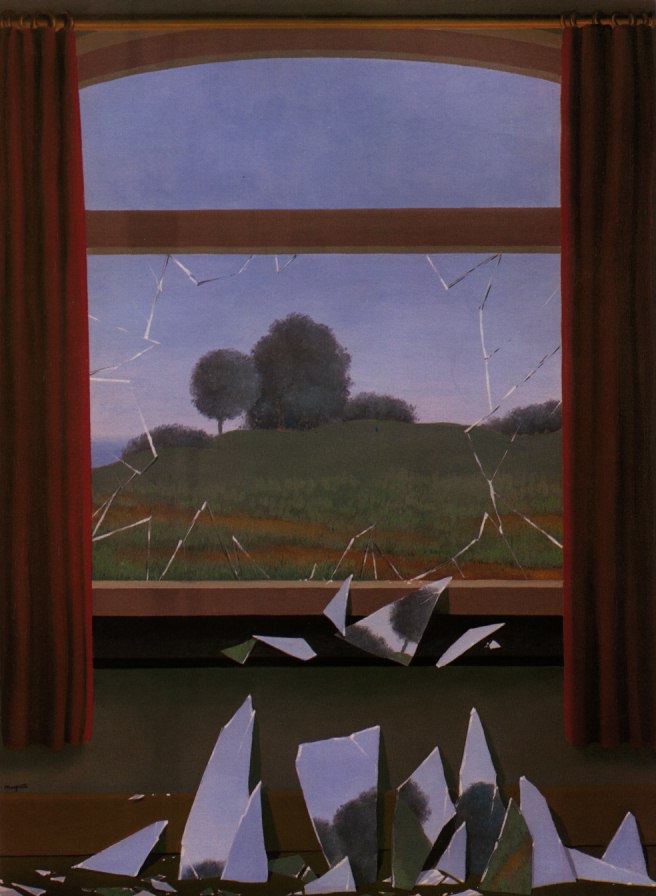
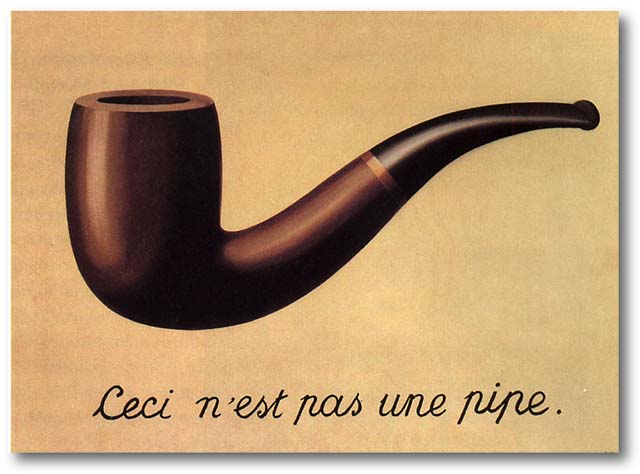
Personally I think Magritte is a central figure in understanding Millar’s large, leaning, oddly shaped stretchers. His Door to Freedom with its broken fragments is an obvious connection – albeit perhaps coincidental. Fascinatingly, in Anthony Byrt’s discussion of Velázquez’s Las Meninas in relation to Millar, he alludes to This is Not a Pipe, another Magritte painting that Foucault once wrote a small book about. Byrt discusses in his essay the famous rendered back of a painting (‘it isn’t a painting, it’s a painting of a painting’s back’) the front of which Velázquez’s figures are admiring, elaborating on the spatial tunnelling and blistering out that Velázquez is expert at – and comparing it eventually with Millar’s markmaking and the effect her painted ‘props’ will have on the La Maddalena space sculpturally – comparable with the illusionistic feats of Tintoretto, Tiepolo and Veronese.
The conversations between Paton and Millar about her visits to Venice and Turin are particularly interesting, especially in relation to the densely ornate architecture of the Scuola Grande di San Rocco in Venice which is crammed full of works by Tintoretto, whose technical wizardry and manipulation of illusory space made him the George Lucas of his day. His paintings helped make her aware of the possibility of physical intervention with architecture.
The history of Millar’s ‘shard’, or ‘Giraffe’ shape is also intriguing, coming from a spatial experiment where in an earlier possible venue last year, she cut into some painted canvases, slotted them into a row of windows and projected them out into the room. She liked the shape she discovered.
Leonhard Emmerling’s text has an interpretative conclusion totally at odds with the other writers. His five part essay is revolves around the distinction between the two Renaissance taxonomies of form, imitatio and inventio, using them to examine possibilities of the autonomy of an artwork (its relationship to the world and society) as elucidated by Frankfurt School philosophers like Adorno. It looks at how the images of Millar’s installation are constructed and how they are located within those questions.
Unlike Millar’s paint Emmerling’s writing doesn’t flow easily. (It’s dense with obscure footnotes, is tortuously longwinded, and needs an experienced, English-speaking editor – somebody like Paton – to shape it and make the vocabulary less monotonous). After considering all variations of Giraffe-Bottle-Gun’s relationship to the world, he eventually concludes that it does not meaningfully interact with it, being independent and in parallel, and not in opposition either – not opening up ‘a privileged view of the world’, nor a ‘utopian alternative’. It is inventio, not imitatio, in its disposition – and hermetic.
As I’ve tried to show, these two Millar books ‘bounce’ nicely off each other. Having only one of them is pointless, because the most informative text is probably Gross’s yet the better images (in terms of Millar’s handling of paint) are found in the bigger hardback. Its reproductions allow the reader to closely examine her painted on /wiped off marks and their internal textures and striations. The design work of this publication though is a little peculiar, individual paintings sometimes being butted together in pairs to make a larger third, or cropped irritatingly at the edges, while all three essays start with first paragraphs entirely indented, the second entirely justified, and third and rest with conventional indenting – confusing because they appear to start with a quote.
So, to summarise, if it is just Millar’s paintings that grab you, go for the thicker book; if it is her installation projects you like, take the skinny one. And if you like seeing how four different writers describe her working process, and how they respond to the marks, get both.